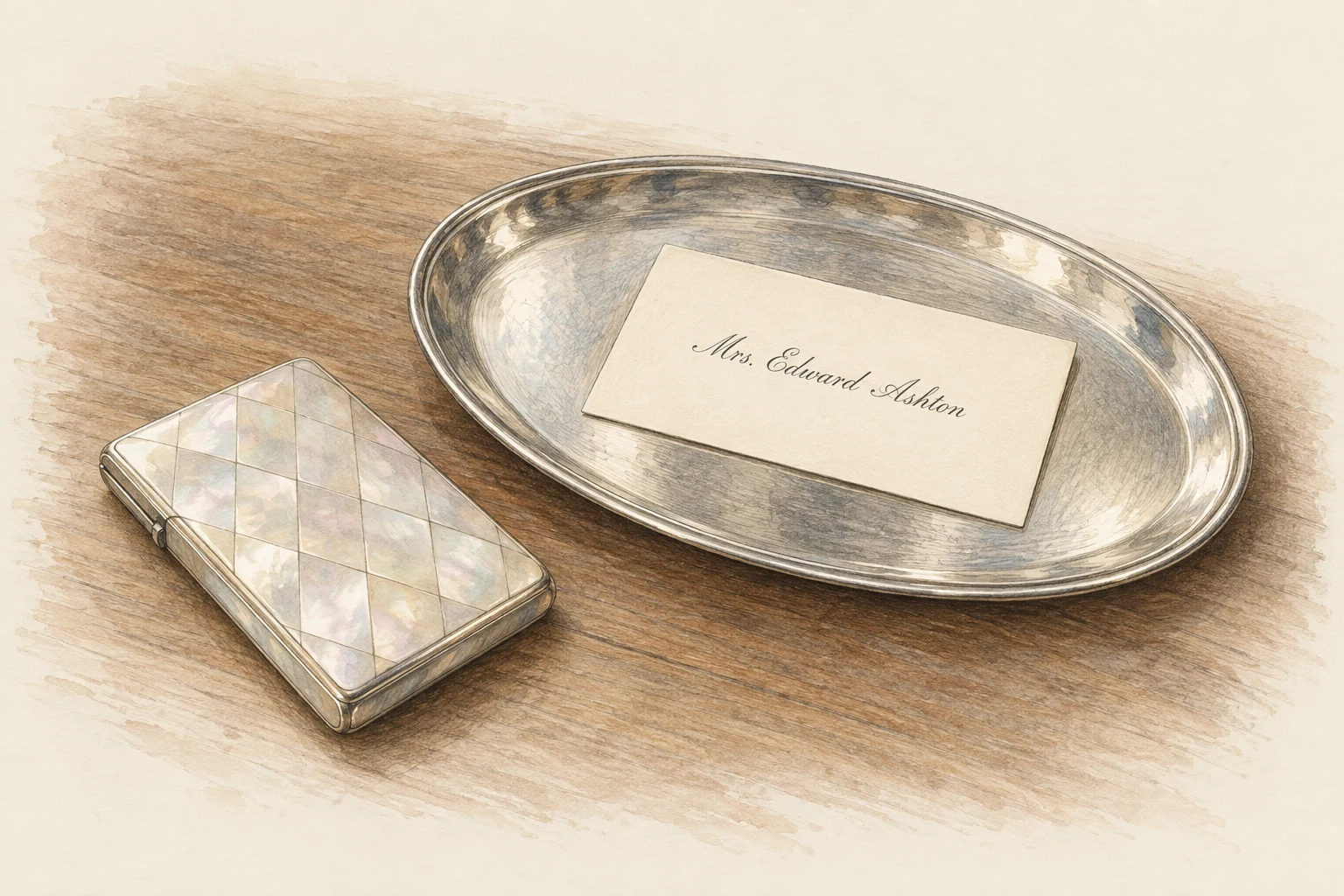
A calling card could be almost absurdly plain.
A name. Perhaps an address. A small rectangle of stiff paper, engraved neatly enough to be handed across a threshold and forgotten in a tray.
Yet from the eighteenth century into the nineteenth, particularly in British and Anglo-American social life, that little card could do extraordinary work. It could announce that someone had arrived in town, mark a visit, acknowledge hospitality, begin or maintain an acquaintance, offer congratulations, express condolence, or announce departure. The card itself said very little. The surrounding custom said almost everything.
Before a telephone could warn that someone was coming, people came.
That simple fact explains much of the system that followed.
By the nineteenth century, a formal caller might arrive at a house and ask whether its mistress was “at home.” The question did not necessarily concern her physical location. A woman could be somewhere inside the building and still be socially “not at home”: she was not receiving callers. Period etiquette manuals are quite explicit about this distinction. If she was available, the visitor might be admitted. If she was not, the visitor left a card.
The door could remain closed without the visit becoming a failure.
The card stayed behind.
The hostess knew who had come. The caller had demonstrated attention. Depending on the relationship, the visit might later be returned. The encounter had not happened, but the call had still been registered.
An entire material culture grew around this exchange. People carried cards in purpose-made cases. Houses kept trays in entrance halls. Servants received them. Cards ranged from austere engravings containing little more than a name to elaborate printed designs, while the cases themselves could be objects of silver, tortoiseshell and considerable workmanship. The Metropolitan Museum describes calling cards as central to social rituals that forged relationships and helped secure one's place within society.
The surviving cards are often more revealing than the manuals.
Sarah Sophia Banks, an eighteenth- and early-nineteenth-century collector, preserved hundreds of examples from the world around her. Together they form something close to a paper map of a social network: names, addresses, invitations, changes of title, dinners and card parties, all surviving because someone once considered these scraps of paper worth keeping. The British Museum still holds them in groups and folders assembled by Banks herself.
One card in the collection comes from Lord and Lady Spencer in 1818. Mrs Banks is requested for dinner at half past six.
Then comes the warning:
“Nobody waited for after seven o'clock.”
An answer was “particularly desired.”
There is something useful about encountering formal society in this mood. From a distance, the world of calling cards can appear leisurely almost to the point of caricature. Apparently dinner still had to begin.
The greater importance of the card lay in the uncertain territory between stranger and intimate.
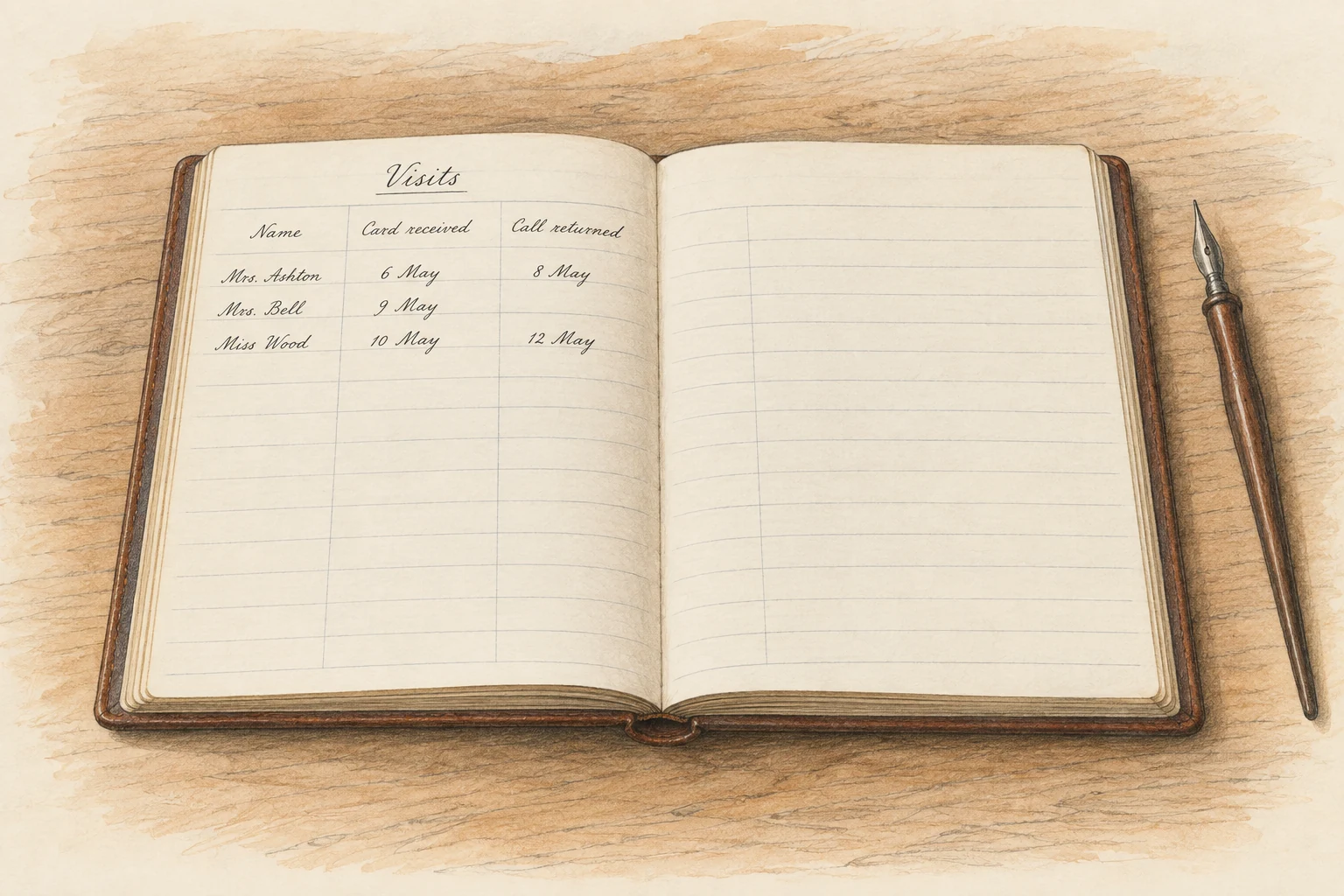
A first call could begin an acquaintance. A returned call might confirm that it would continue. Cards left after entertainments recognized hospitality. Someone arriving in town could announce the fact to a wide circle without writing individual letters. For those with enough acquaintances to make the system difficult to remember, etiquette manuals actually recommended keeping a visiting book recording whose cards had been received, which calls had been returned, and who now owed one to whom.
The card therefore gave form to relationships that had not yet become friendships.
That distinction mattered. Someone might be pleasant company without becoming intimate. An invitation did not necessarily create unlimited access to a household. Formal visiting allowed people to acknowledge one another while preserving a boundary around private life.
It also provided a way for an acquaintance to end without a confrontation. One British manual states quite plainly that if cards left after an initial social encounter were not acknowledged, the caller should understand that “the acquaintance is to proceed no further.” Another advised that residents who did not wish to continue knowing newcomers could simply stop leaving cards or calling.
There was no need to announce that two people would henceforth cease to know one another.
Sometimes the cards simply stopped.
Predictably, a useful system accumulated rules.
An 1883 American guide instructed a married woman who found the mistress of a house “not at home” to leave her own card and cards belonging to her husband; if she were merely leaving cards rather than calling, three could be handed over at once. British manuals prescribed very similar routines. What looked like one simple visit could therefore involve several pieces of pasteboard representing people who had never approached the door themselves.
Other conventions were less stable. Cards were sometimes turned down at a corner to show that they had been left personally or to convey another social meaning. The precise codes varied by place and period, and later etiquette writers could already describe older forms of corner-turning as obsolete.
That variation is worth remembering. Historical etiquette is often presented as though everyone once consulted the same enormous code book. In reality, customs changed by period, place and social circle just as they do now.
Some signals were clearer.
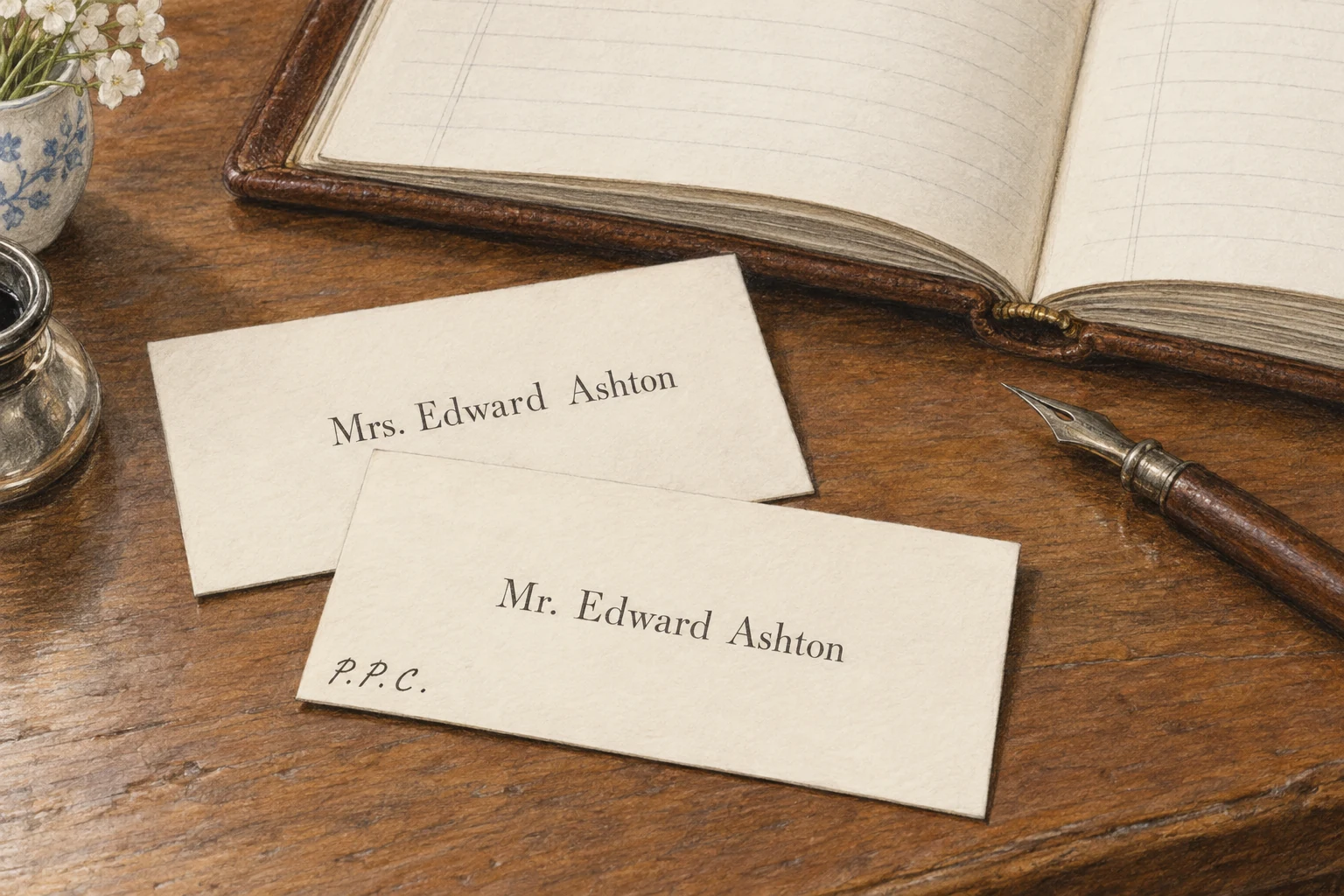
Before leaving town for a considerable absence, a person might send or leave a card marked P.P.C.: pour prendre congé — to take leave. One British manual explained that the object was to avoid a round of personal farewells while preventing unanswered invitations or letters from giving offence.
Three small letters could say something roughly equivalent to:
I am going away. I have not forgotten you. Do not mistake my absence for discourtesy.
The elegance of that solution is easy to miss beneath the etiquette.
By the late nineteenth and early twentieth centuries, however, the rules surrounding cards could also become exhausting. Manuals devoted pages to their dimensions, typography, titles, mourning borders, married names, daughters, first calls, returned calls, receiving days and the proper number to leave under particular circumstances.
A convention that helped organize social life had accumulated an administrative burden of its own.
Even contemporaries could see the absurdity.
When Emily Post considered visiting cards in 1922, she repeated a joke that a woman supposedly needed only a hairpin as a mechanical tool, adding that with “a hair-pin and a visiting card” she could meet most emergencies. More importantly, Post could already see that one of the card's oldest functions was weakening. Leaving quantities of them at acquaintances' doors was, she wrote, going gradually out of favour in fashionable circles, even while cards remained useful for invitations, condolences, congratulations and other messages.
The card survived.
The social machinery around it was changing.
The telephone offered a way to discover whether someone was available before appearing at the door. Formal visiting became less central to ordinary sociability. Fewer households maintained the domestic arrangements on which elaborate calling had depended. The work once done at the threshold began moving elsewhere.
Not the underlying social work.
We still need to announce ourselves, acknowledge hospitality, accept and decline, maintain acquaintances, allow others access without surrendering all privacy, and sometimes let a relationship end without turning its ending into an event.
The tools are different. A missed call records an attempted conversation. A message announces that someone was thinking of us. An invitation can be accepted without anyone entering a drawing room. Gillian Russell, writing about the eighteenth-century visiting card, has aptly described it as a new form of social media that in some respects anticipates modern text messaging.
The comparison should not be taken too far. A calling card belonged to a particular social world, much of it shaped by class, domestic service and elaborate distinctions between acquaintance and intimacy.
But the problem it addressed remains recognizable.
People need ways to approach one another without demanding too much.
For generations, a small engraved card allowed someone to say, in effect:
I was here. I remembered you. You need not let me in.
Its importance was never really in the name printed upon it.
What mattered was that everyone knew what its arrival meant.