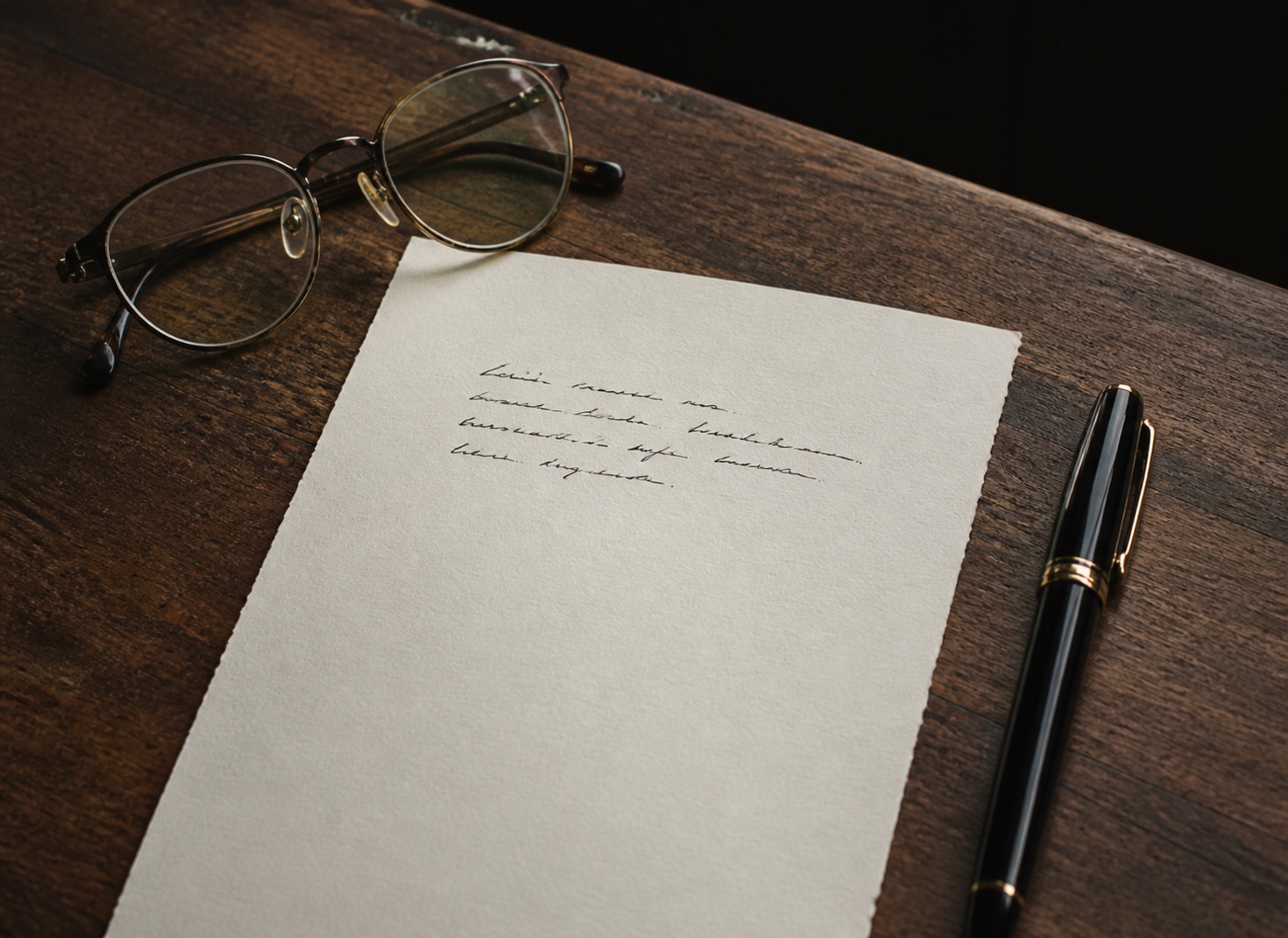
There are moments when saying thank you is enough.
Someone holds a door while your hands are full. A colleague catches an error before it becomes a problem. A friend brings coffee. You thank them, they understand, and nothing more is required.
Then there are kindnesses that seem to ask for a second moment.
Someone welcomes you into their home for a weekend. A wedding gift arrives from far away. A neighbour gives an afternoon to help when there was nothing in it for them. A friend remembers something you had forgotten mentioning months ago and chooses a gift with unmistakable care.
You may already have said thank you. The note does something different.
It returns to the kindness after the moment has passed and says: I noticed what you did. I remember it. It mattered.
That is why the thank-you note has survived so many changes in correspondence. Its value was never really the stationery.
Its value is attention made visible.
Write as you would speak
Older etiquette books can make correspondence sound more forbidding than it was.
The rules surrounding calling cards, forms of address, mourning paper, invitations and social introductions could be intricate. Yet when nineteenth- and early twentieth-century writers reached the letter of thanks itself, their advice often became remarkably plain.
In 1860, Florence Hartley advised that an acknowledgement of a favour should be simple, grateful and graceful. Her best instruction was simpler still: imagine the friend before you and “write, even as you would speak.”1
More than half a century later, Florence Howe Hall described the familiar bread-and-butter letter: the short note sent after staying in someone's home. It need not be long, she wrote, but it should convey cordial appreciation.2
Emily Post was similarly impatient with unnecessary grandeur. Her 1922 examples of thank-you letters are full of personality. A woman delights over a chair that her husband and children are already trying to claim. Another admits that she opened a Christmas parcel early because she could not resist it. The language is energetic, affectionate and occasionally imperfect.
It sounds like people.
That matters because formality can easily defeat the purpose of the form. A thank-you note written as though it were an official proclamation may fulfil an obligation while concealing the very gratitude it was supposed to express.
A good note does not need impressive language.
It needs the writer to be present in it.
A second act of gratitude
The note is sometimes misunderstood as a replacement for thanking someone in person.
Usually it is not.
If somebody hands you a gift, you thank them. If a host has spent an evening cooking for you, you do not leave the table silently because a card will be arriving on Tuesday.
The note follows the gratitude already expressed.
For some ordinary exchanges, that second act would be excessive. For others, it feels proportionate. The greater the hospitality, thought, effort or significance involved, the stronger the case for returning to it deliberately.
That principle is more useful than trying to memorize a catalogue of occasions.
A handwritten note after a substantial act of hospitality makes sense because hospitality required something of the host. A note after receiving a meaningful gift makes sense because somebody spent time choosing, making or sending it. A note after being helped through a difficult period may matter because the assistance deserves more recognition than could comfortably be given in the moment.
Modern etiquette guidance has become more flexible about medium, and reasonably so. A text can thank someone for coffee. An email can be entirely appropriate in an established professional relationship. A telephone call may mean far more to a close relative than a card through the post.
But the principle remains useful:
Let the form of the thanks bear some relationship to the kindness received.
That is not ceremony for ceremony's sake. It is proportion.
Specificity is the substance
The weakest thank-you notes tend to fail in one of two directions.
They are either so generic that the recipient could be anyone—
Thank you very much for your thoughtful gift. It was greatly appreciated.
—or so concerned with sounding elegant that the writer disappears behind the language.
Specificity solves both problems.
The old examples understood this instinctively. Emily Post's correspondents talk about where the mirror will hang, how the afghan feels, who is trying to steal the new chair.3 They do not merely certify receipt of an object. They tell the giver what happened when the gift entered the recipient's life.
That is what makes gratitude convincing.
A host does not need to hear that dinner was “lovely.” Tell her you are still thinking about the conversation after everyone else had gone home.
A friend who gave you a book does not need a miniature review. Tell him that he remembered exactly the subject you had been trying to understand.
The person who helped when things were difficult need not be praised in grand terms. Name what the help allowed you to do, or what became easier because they were there.
Specificity is not decoration added to gratitude.
It is how another person knows that their effort was actually seen.
The value of the hand
Handwriting is only the medium. Its advantage is that it makes effort unusually visible.
A handwritten note has been chosen, written, addressed and sent. The words arrive attached to physical evidence that someone stopped what they were doing long enough to put them there.
That does not make handwriting morally superior to every digital message. There are relationships in which a text is warmer because it is natural between those two people, and circumstances in which speed matters more than paper.
The better distinction is between convenience and significance.
For small thanks, convenience is often entirely appropriate.
When the kindness itself carried unusual thought, effort or feeling, choosing a slightly less convenient form can be part of the response. The inconvenience is small, but it communicates something useful: this was worth stopping for.
There is even some evidence that we are poor judges of how welcome such expressions will be. In experiments involving gratitude letters, Amit Kumar and Nicholas Epley found that writers tended to underestimate how positive recipients would feel and overestimate how awkward the gesture would seem.4
Perhaps that explains some of our hesitation. We worry about finding exactly the right words when the recipient is more likely to notice that we chose to write them at all.
Prompt is good. Late is still worth sending.
Traditional etiquette was emphatic about promptness.
Hall expected the post-visit letter within a few days. Post advised that notes of thanks should be short and sent with as little delay as possible.2 3 The reasoning is easy to understand: gratitude is most convincing when it has not apparently been remembered as an administrative debt three months later.
Promptness remains better practice.
But lateness does not erase gratitude.
A peculiar thing happens when a note has been delayed. The embarrassment of being late becomes the reason for delaying it further. Two weeks feels awkward, then a month feels impossible, and eventually a kindness that genuinely mattered goes unacknowledged because the writer missed an imaginary deadline.
Modern etiquette advice is wiser on this point: send the late note.5
There is no need to turn half of it into an apology. Acknowledge the delay briefly if it is substantial, then give the gratitude the space it should have had in the first place.
The purpose was never perfect administrative compliance.
It was to make sure that kindness did not pass unnoticed.
What remains
The forms around correspondence will continue to change.
Paper has already surrendered much of ordinary communication to the telephone, email, messaging and whatever comes after them. Some of those changes are improvements. A person should not have to wait three days for the post to learn that flowers arrived safely.
But speed solves a different problem.
A thank-you note belongs to the small category of communication whose value can actually increase when we refuse to make it effortless.
Not every favour deserves one. Not every relationship needs one. Gratitude does not become more sincere because it has been written on expensive paper.
But now and then, someone does something worth returning to.
Write the note.