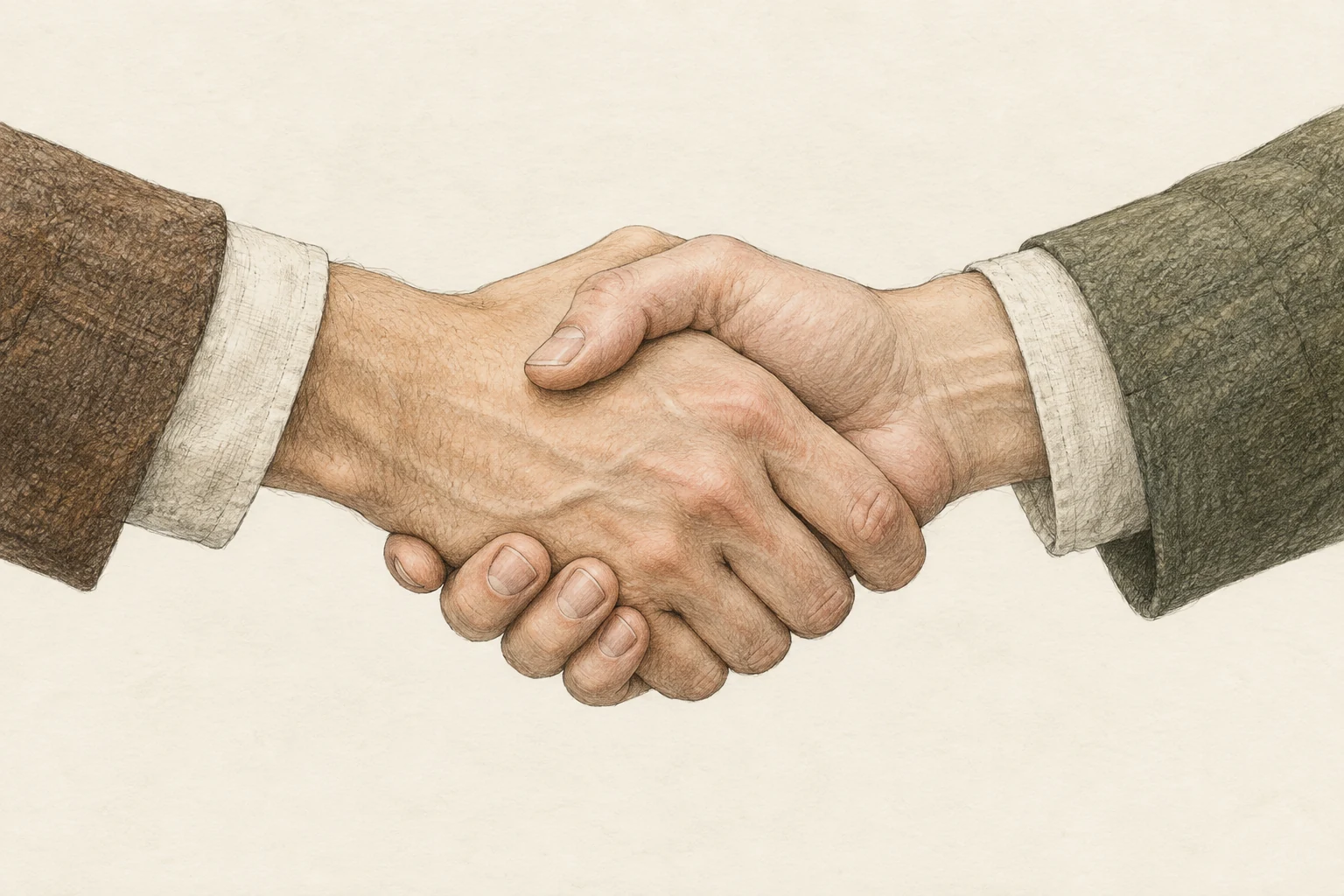
A handshake is a remarkably small ceremony.
One person extends a right hand. Another takes it. The hands move briefly together and separate. The entire exchange may last two seconds, yet in those seconds we can welcome a stranger, begin a business relationship, congratulate an opponent, confirm an agreement, repair a quarrel or simply acknowledge that another person has arrived.
It is so familiar that its oddness has largely disappeared. There is no obvious practical reason that meeting another person should require grasping one of their hands and moving it up and down. We do it because both people understand what the action means.
The usual explanation is wonderfully simple. Long ago, the story goes, a person extended an empty right hand to show that it held no weapon. The other person did the same. Perhaps the hands were even shaken to dislodge a dagger concealed in a sleeve.
It is a memorable explanation. It is also more theory than history. The origins of hand-clasping are too old, too geographically widespread and too varied in meaning to be reduced to a single invention. The idea that empty hands demonstrated peaceful intent is plausible, but difficult to prove as the origin of the custom. Historians can trace ancient examples of people joining hands as signs of alliance, trust, farewell, agreement and reconciliation; there is no surviving moment in which somebody devised the modern handshake as a weapons inspection.
What can be said with confidence is that giving another person your right hand has carried meaning for a very long time.
One of the oldest known images of such a pledge dates from the ninth century BC. An Assyrian king and a Babylonian king are shown facing one another with their hands joined. They are armed, elaborately dressed and surrounded by the authority of kingship, which makes the scene particularly interesting. Whatever movement may or may not have accompanied it, neither man is shown bowing before the other. At that moment, the hands meet.
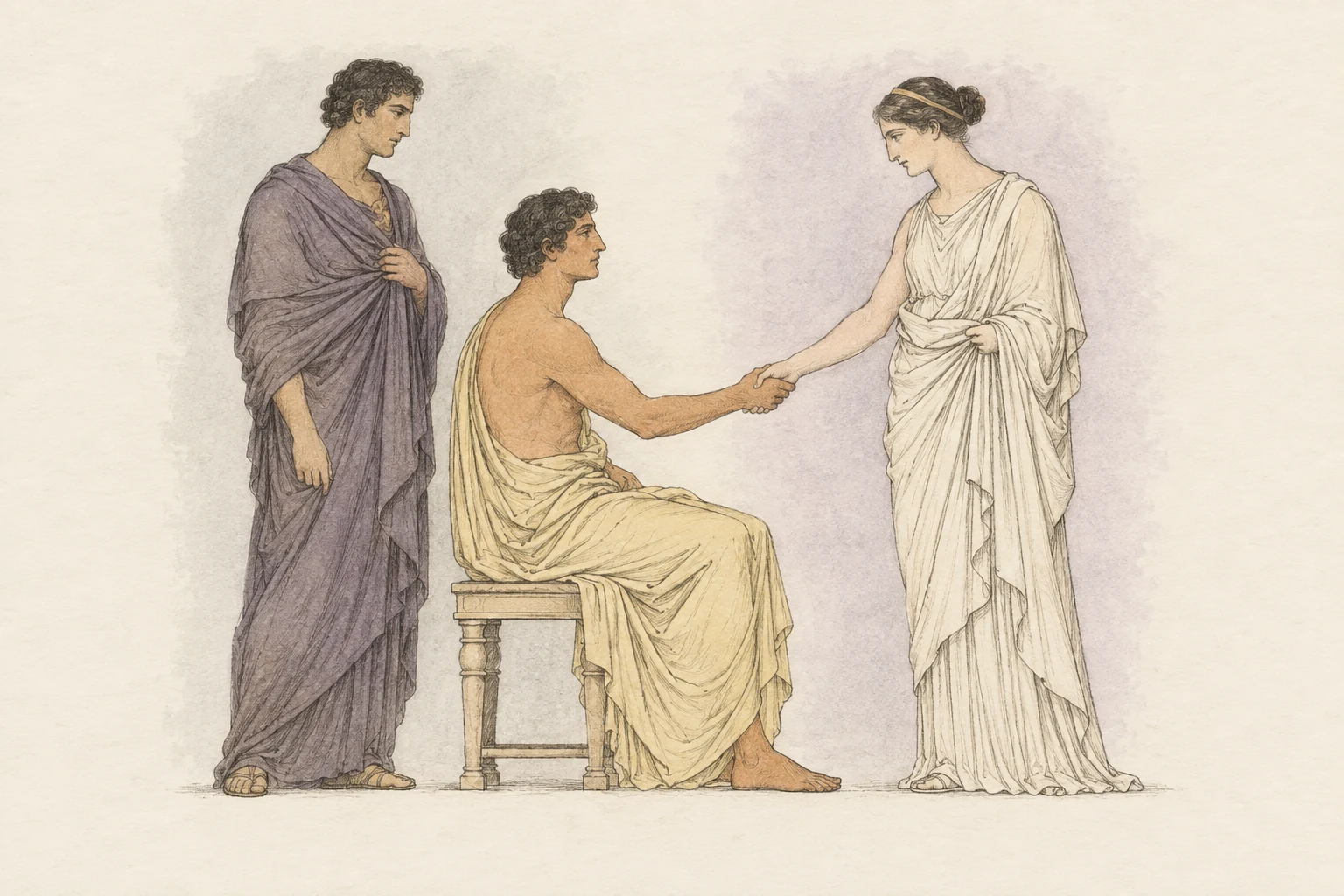
The Greeks likewise represented the joining of right hands, known as dexiosis, while related forms appeared among Etruscans and Romans. In diplomacy, reconciliation and agreements, joined hands became a useful symbol precisely because two people could perform the same action toward one another. It did not mean they were equal in every other respect. It meant that for the purpose of the pledge, each stood opposite the other and participated in the same act.
That could occasionally require rather a lot of trust.
The fourteenth-century chronicler Jean Froissart tells of a parley during the long Anglo-French wars in which a man inside a besieged castle extended his right hand through an opening in the door as a pledge of good faith. His opponent seized it and threatened to nail it to the door with a dagger unless the castle was surrendered.
The castle was surrendered.
It is an unusually literal demonstration of the risk involved in putting one's hand into somebody else's.
More commonly, joined hands signalled that hostility had been suspended. Late in the sixteenth century, Shakespeare could use the action without explanation. In As You Like It, Touchstone describes two quarrelling men making peace: “They shook hands and swore brothers.”
The custom, then, did not suddenly appear in the eighteenth century. Recent scholarship has found evidence of handshaking as an English greeting considerably earlier, although its use varied by period, status and circumstance and is difficult to reconstruct from the scattered historical record. What changed over time was how widely and routinely it could be used.
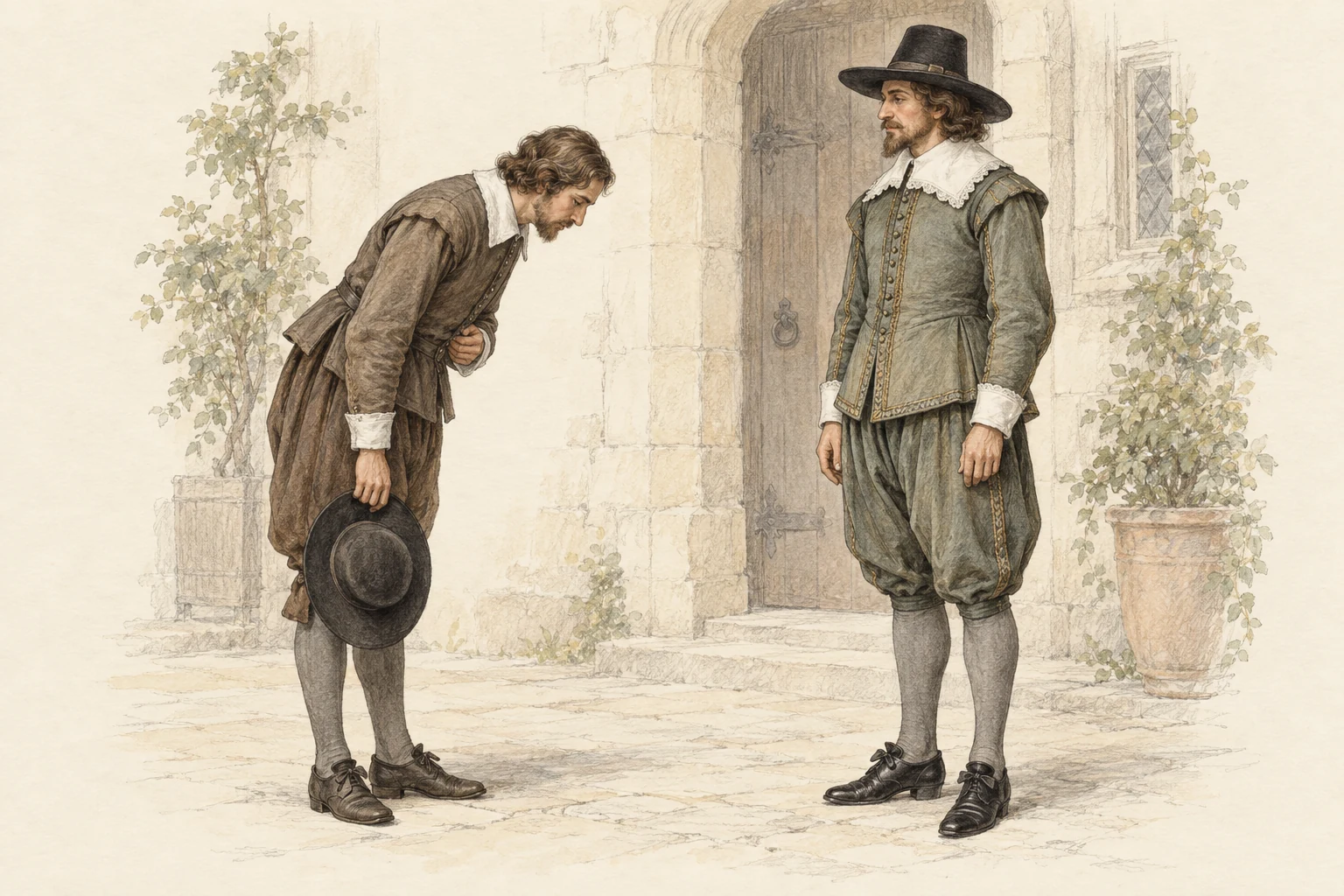
In seventeenth-century Britain, fashionable greeting was still heavily concerned with rank. A lower-ranking man might remove his hat and bow before a social superior, receiving a lesser acknowledgement in return. A woman might make a deep curtsey. Such greetings were understood partly through their inequality: the body itself helped display who owed deference to whom. Etiquette manuals taught those distinctions carefully.
Handshaking existed beside these forms, but it was not the formal language of fashionable hierarchy. There is evidence of ordinary men using it with one another, particularly where a degree of formality was wanted. In Scotland, one writer in 1607 approvingly described “the good olde Scottish shaking of the two right hands together,” while complaining that fashionable young Scots had taken instead to “bowing and scraping.”
The complaint has aged rather well. We still use bowing and scraping to describe excessive deference. The supposedly old-fashioned Scottish handshake won the longer contest.
Its spread was helped by people who had practical reasons to meet one another without first resolving exactly who outranked whom.
Merchants were among them. Traders used handshakes to confirm bargains and agreements. The action was not itself an unbreakable legal contract, but it carried the weight of a public pledge. A merchant whose business depended upon reputation had good reason to care about being known as someone whose hand could be trusted. Across commercial networks, men of different wealth, nationality and religious affiliation might therefore meet one another in a form that was reciprocal even when almost nothing else about their circumstances was equal.
At roughly the same time, another group was giving the handshake a much more deliberate social meaning.
The Quakers rejected many of the ordinary performances of rank. Friends dressed plainly, used familiar forms of address, and declined to bow or curtsey to people merely because society considered those people their betters. Men and women alike shook hands regularly, including in religious and social life. The practice could cause offence precisely because it refused to perform the expected hierarchy.
The Quakers did not invent the handshake. By then the action was ancient, and evidence shows that English people were already using it as a greeting. What the Friends did was make it unusually visible, regular and principled—and in doing so helped popularize it.
This matters because manners are often imagined as something that begins at court and trickles downward: aristocrats establish the form, fashionable society copies it, and eventually everybody else learns the rule. Handshaking in Britain appears to have travelled by a less orderly route. Merchants used it in business. Quakers used it as a matter of conviction. Ordinary people already knew it. The custom moved upward, downward and sideways through society rather than descending neatly from the top.
The country around it was changing as well.
In 1700, most Britons still lived in small settlements. By the middle of the nineteenth century, a majority lived in towns. Growing cities brought together merchants, professionals, artisans, labourers, visitors and strangers in numbers that made old social calculations more difficult. In a village, the person approaching might be known along with his family, occupation and place in the local order. On a busy urban street or in a commercial room, that certainty weakened.
A greeting built around rank works best when everybody knows the rank.
A handshake requires less information.
Two people approach. One offers a hand. The other accepts. Neither needs to decide how deeply the other deserves a bow.
None of this made Britain suddenly egalitarian. Wealth remained wealth, titles remained titles, servants remained servants, and people continued bowing, curtseying and removing their hats long after handshaking became familiar. Old and new greetings overlapped, chosen according to circumstance. Historian Penelope Corfield describes the handshake's rise more carefully: it acquired increasingly egalitarian meanings within a society that remained anything but completely equal. Other recent scholarship similarly cautions that handshakes could still express and negotiate status rather than simply erase it.
By Jane Austen's time, the custom was familiar enough to appear naturally in fiction. In Sense and Sensibility, Marianne Dashwood's emotional request that Willoughby shake hands with her matters because his reluctant response communicates rejection. In Emma, the same action can signal warmth and social acceptance. Austen does not pause to explain it. Her readers are expected to understand what has passed between the characters.
That may be the surest sign that a custom has taken root. It no longer needs explaining.
Britain's growing reach also carried the familiar greeting beyond its own shores. Quaker emigrants had already helped establish regular handshaking in Britain's North American colonies, and as British merchants, explorers, soldiers and settlers travelled through expanding networks of trade and empire, they carried the habit farther still. Britain did not invent the handshake, nor was it the gesture's only route around the world; hand-clasping had deep and varied roots in other cultures. But an increasingly ordinary British greeting was now travelling with people whose movements stretched across continents.
By the nineteenth century, the handshake had acquired one of the qualities that would make it remarkably durable: it could travel. It could seal a bargain, begin an introduction, congratulate a victor or demonstrate reconciliation. Its precise etiquette changed, as etiquette always does, and it lived alongside older local forms of greeting rather than simply replacing them. The basic architecture, however, remained remarkably stable: one hand offered and another returned.
Perhaps that is why the handshake survived while so many more elaborate forms of greeting weakened.
A bow can be performed alone. One person gives it; another receives it.
A handshake cannot.
If the second person does not offer a hand, there is no handshake. Both people must complete it together.
That does not make them equals beyond the moment. One may be richer, older, more powerful or more celebrated than the other. History is full of handshakes between people whose circumstances were profoundly unequal.
But for those few seconds, neither person performs the greeting upon the other. They perform it with one another.
The handshake did not make society equal.
It did something smaller.
It gave two people the same gesture to perform.