Fire was once one of the organizing facts of a house.
It cooked the food, warmed the people, dried what was wet and gave light after the sun had gone. A household could not simply decide that smoke was unpleasant and do without the flame producing it. Fire had to come indoors.
For centuries, that meant the house had to make room not only for the fire, but for its smoke.
In the open-hall houses of medieval England, the principal fire commonly burned on a hearth within a tall central room. There might be no ceiling directly above it. Smoke rose toward the rafters and found its way out through openings in the roof, while the height of the hall kept sparks farther from combustible timbers and floors. Surviving houses still preserve soot-darkened roofs from the years when the fire below was open to them.
To modern eyes, all that empty height can look extravagant.
It was not empty.
The fire was using it.
That becomes important because the story of the chimney is not merely the story of getting smoke outside. Once smoke had a route of its own, the space it had occupied became available for something else.
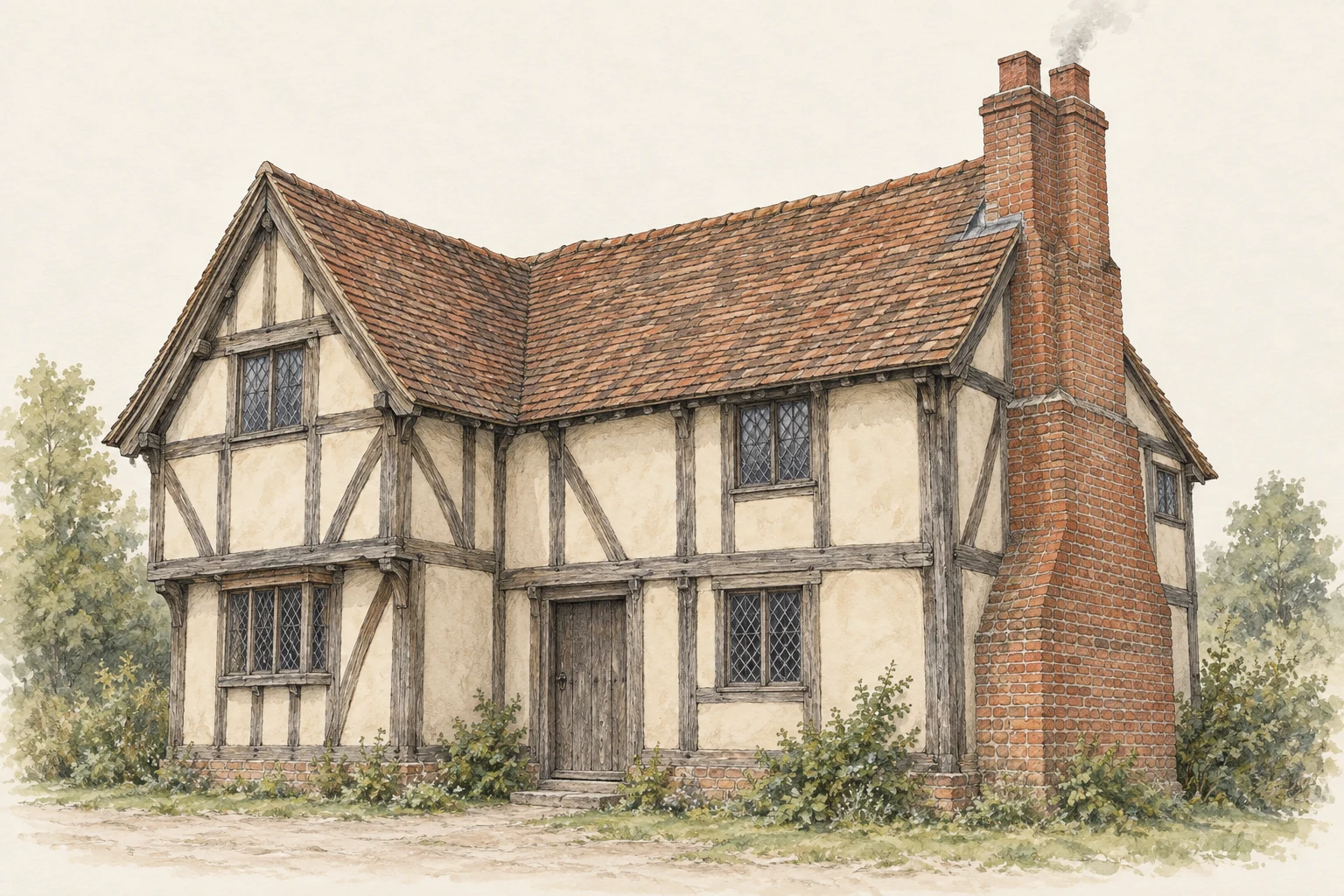
Chimneys were not suddenly invented in Tudor England. Fireplaces and flues existed in medieval buildings long before they became ordinary features of English domestic life. Their spread through houses was gradual, uneven and strongly affected by wealth, available materials and local building traditions. Historic England notes that masonry chimneys were appearing in farmhouses by the later sixteenth century while cottages generally adopted them later.
The transition was not always elegant.
Some timber-framed houses used smoke bays: sections of the building enclosed to contain smoke and guide it upward. Others used smoke hoods. In surviving buildings, an early smoke bay can sometimes be found with a brick chimney later inserted inside it—the architecture recording one attempted solution on top of another.
That untidiness is useful to remember. People did not move neatly from primitive hearth to perfect chimney. They experimented with controlling something they could not live without.
And then the house began to change around the result.
Architectural historian LeRoy Dresbeck summarized one consequence in five words:
“The chimney fostered the small room.”
With smoke captured by a fireplace and carried upward through a flue, a room no longer needed the same height simply to tolerate its fire. Lower ceilings became practical. Smaller spaces could be heated more effectively. Most importantly, in houses that had contained an open hall, the volume above that hall could now be put to use.
A floor could go in.
This alteration survives in house after house. At Wayside in Chobham, for example, the open hall was first provided with a smoke bay; a masonry chimney was later inserted into it and the upper floor completed. Elsewhere, Historic England records medieval halls that were subsequently ceiled over, furnished with chimneys and turned into two-storey domestic space.
The walls of such a house did not necessarily move outward.
Yet the household gained another layer of life.
Where smoke and rising heat had once occupied the space above a communal hall, there could now be a chamber. A great room could become two levels. More of the house could be enclosed, heated and inhabited.
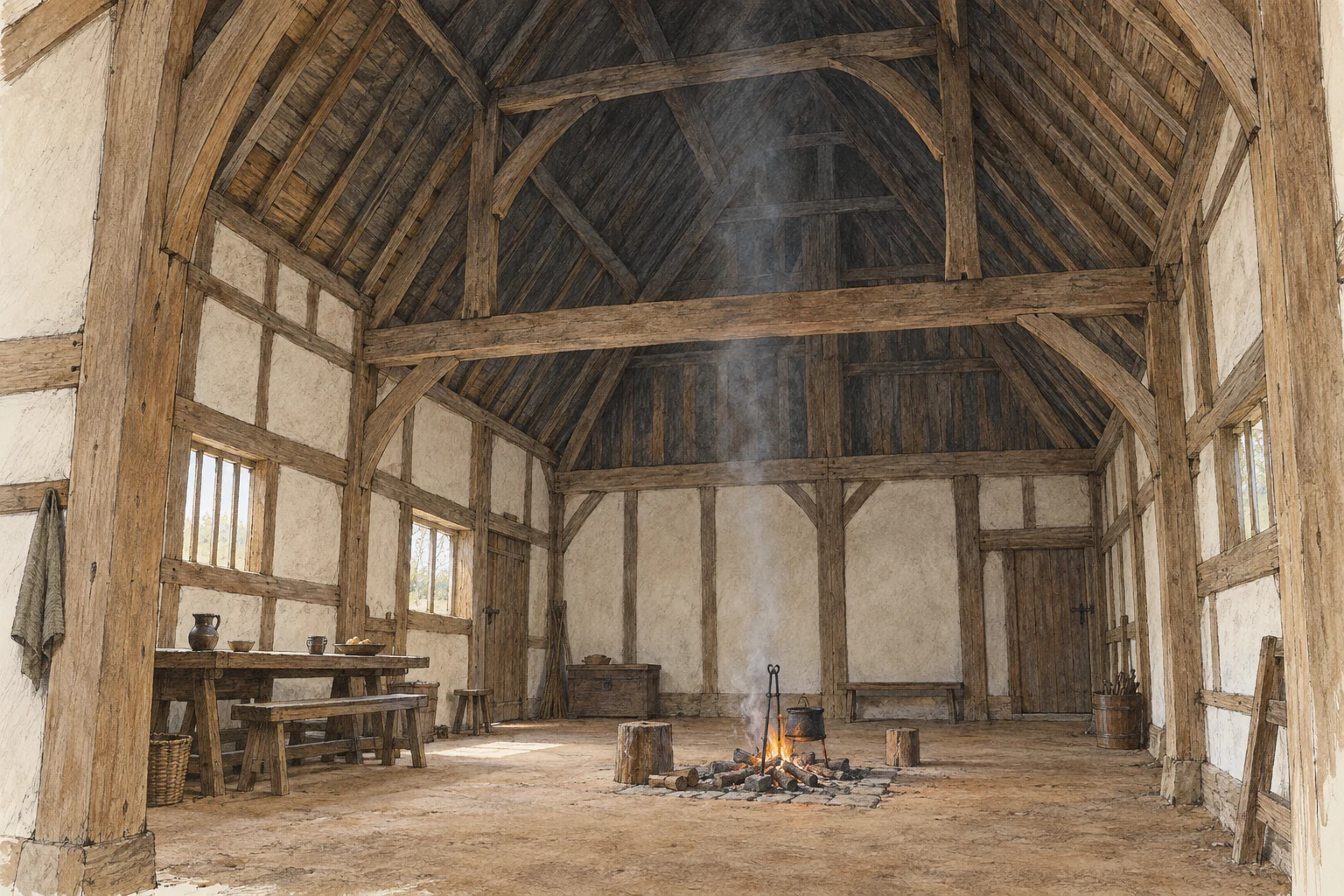
Open to the roof
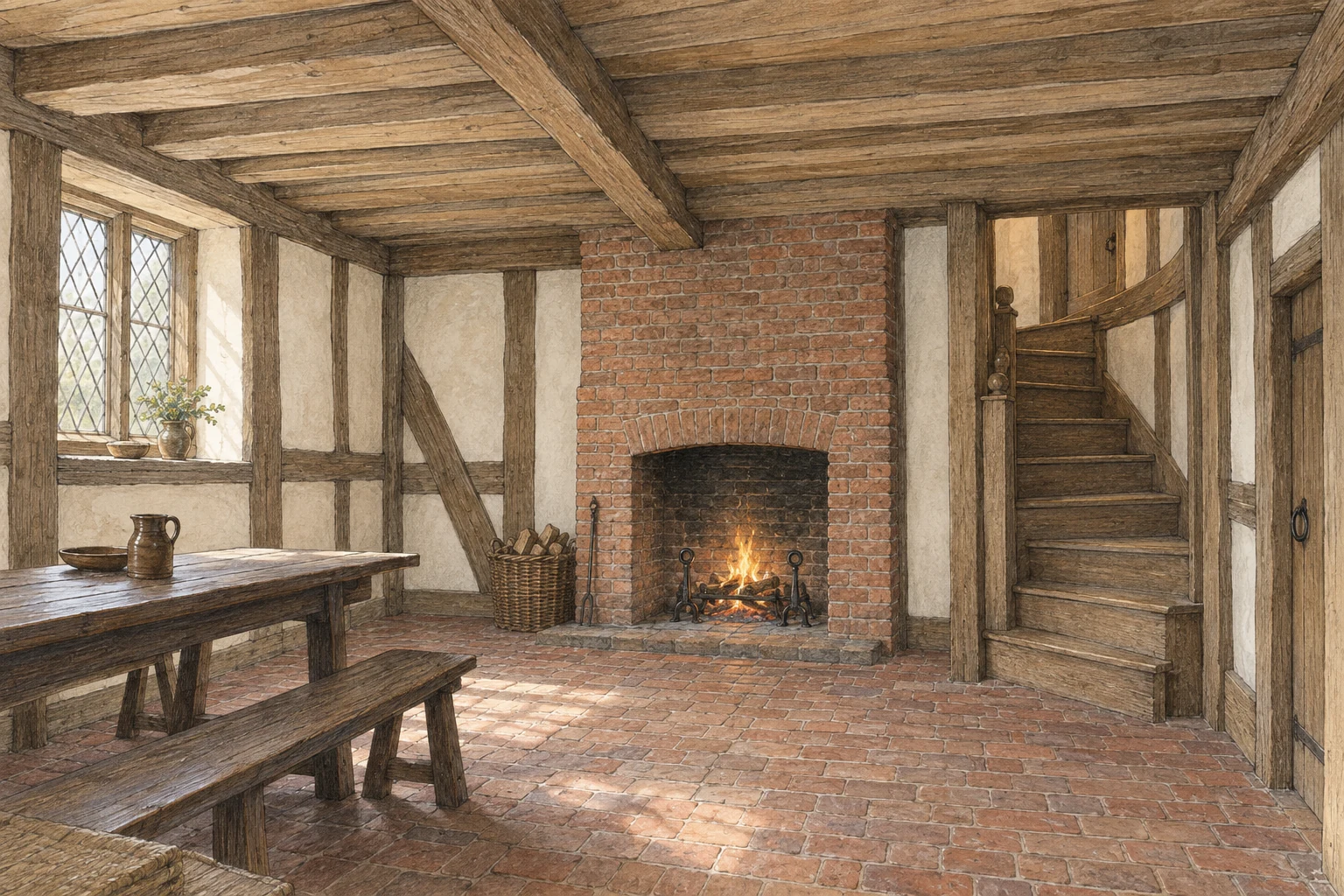
A floor above the hall
The chimney did not single-handedly produce this transformation. Some houses acquired chimneys while their halls remained open, and changing wealth, family organization, ideas of comfort and building techniques all mattered. The important point is more modest.
Controlling smoke made new arrangements possible.
Those arrangements changed more than floor plans.
The medieval hall had already been a social space as well as an architectural one. It was the principal living room of the household, often centred on its hearth, with service rooms toward one end and more private accommodation toward the other. Eating, hospitality and much of everyday household life converged there.
Smaller, separately heated rooms loosened some of that concentration.
A parlour could offer greater withdrawal. A chamber could become easier to occupy in comfort. Different parts of domestic life could take place at the same time without everyone depending upon one large heated volume.
The chimney did not invent privacy, any more than the hallway did.
It made privacy warmer.
That may sound like a small distinction until winter arrives.
A private room that cannot be heated is rather less useful than one that can.
As houses became more subdivided, fireplaces multiplied with them. Historic England notes that rising expectations of comfort led to fires being provided in more parts of the building; by the eighteenth and nineteenth centuries, increasingly complex chimneys could contain several flues, each serving a separate fire.
The social consequence is easy to overlook because the mechanism is so ordinary.
One principal fire encourages convergence.
Several fires permit choice.
Someone could remain in a parlour while another person occupied a chamber. Work could continue elsewhere. A guest might be received in one heated room while the rest of the household carried on in another.
Fire still brought people together.
It no longer required everyone to be together in the same place.
New rooms then acquired lives of their own. Their purposes became more distinct; habits formed around them; and some of those habits eventually hardened into the traditions of domestic life. Dining moved increasingly into rooms intended for dining. Receiving visitors developed its own spaces. Bedrooms became more private territory. The chimney was not responsible for all of this, but the ability to make separate rooms habitable helped the change along. Dresbeck himself connected the development of smaller heated spaces with increasingly differentiated household functions and greater privacy.
There is something almost paradoxical in what happened next.
The chimney had begun as a way of controlling fire—to constrain it, collect its smoke and reduce the demands it made upon the room.
Then people began celebrating it.
Outside, chimney stacks became prominent parts of the architecture. Inside, the opening acquired surrounds, mantels, carved stone, timber, tile and ironwork. Historic England notes that in historic interiors the chimneypiece was often designed deliberately as the visual focus of the room.
Furniture turned toward it.
Clocks and objects accumulated above it.
Chairs gathered around it.
The apparatus built to contain the fire became the place people chose to look at.
And new traditions gathered there too.
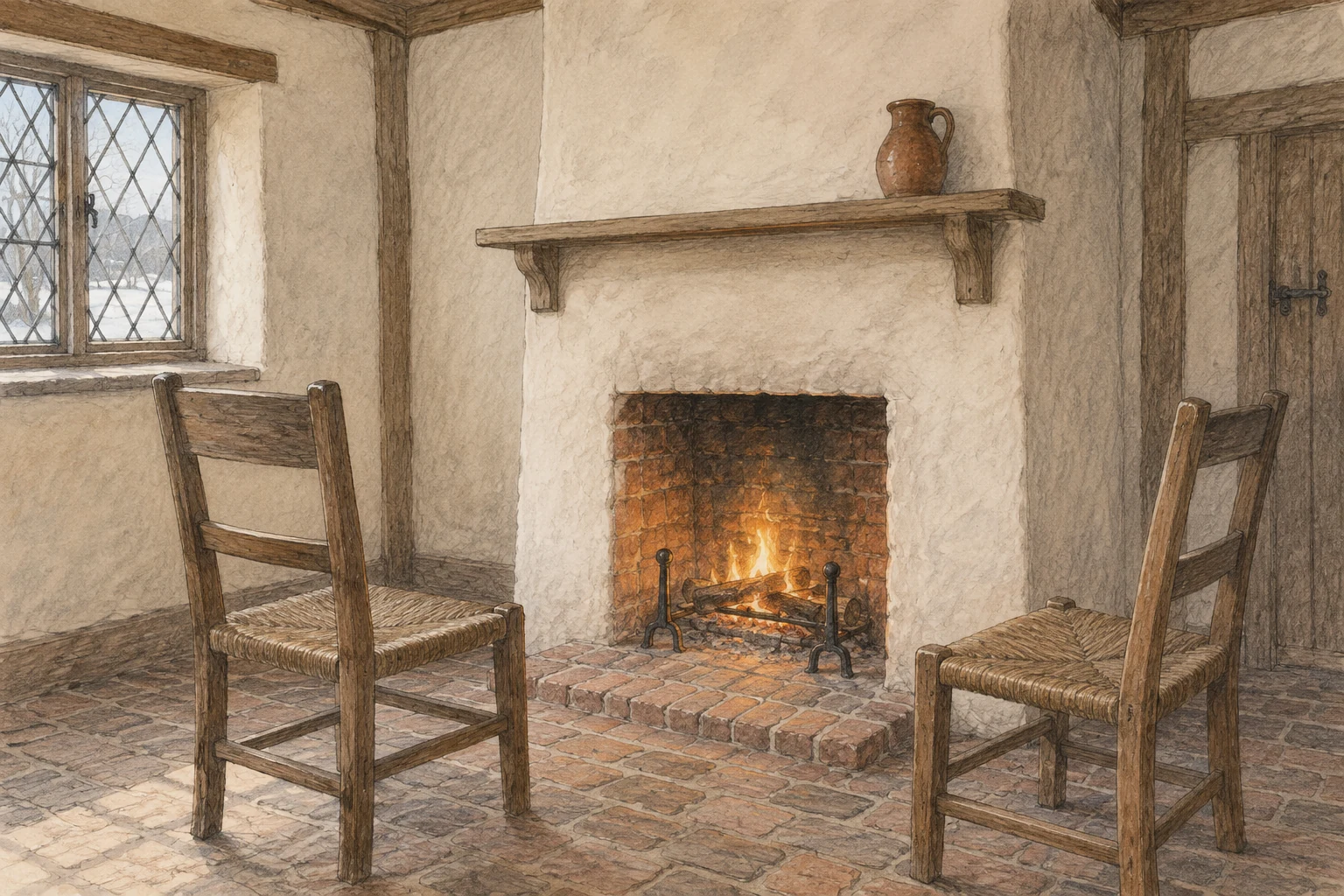
The medieval open hearth had brought a household into a large common space because that was where the essential fire happened to be. The later fireplace offered something more deliberate: a defined place to sit beside warmth. The domestic image of an evening by the fire—the mantel, the chairs, the conversation, the winter gathering—is therefore not simply an ancient survival of life around a flame. It belongs to a house that had learned to control the flame well enough to build a room around the experience of it.
Today, an old chimney can seem like the opposite of progress.
The fire may be gone. The flue may be blocked. Central heating warms every room without requiring anyone to carry coal or sweep ash. A chimney breast projects inconveniently into the floor plan, taking up space that a renovator might prefer to reclaim.
Historic England even has to warn modern owners that the apparently useless chimney breast may still be structurally important.
It is an odd end for something that once helped make that floor plan possible.
The mass of brick rising through an old house carried smoke away so that ceilings could close overhead, rooms could shrink, fires could multiply and different parts of domestic life could separate from one another.
Then those rooms acquired purposes.
Those purposes acquired habits.
And some of those habits became traditions.
Fire had always made human life possible.
The chimney did something different.
It gave the fire a place of its own—and, in doing so, helped give the rest of the house places of theirs.