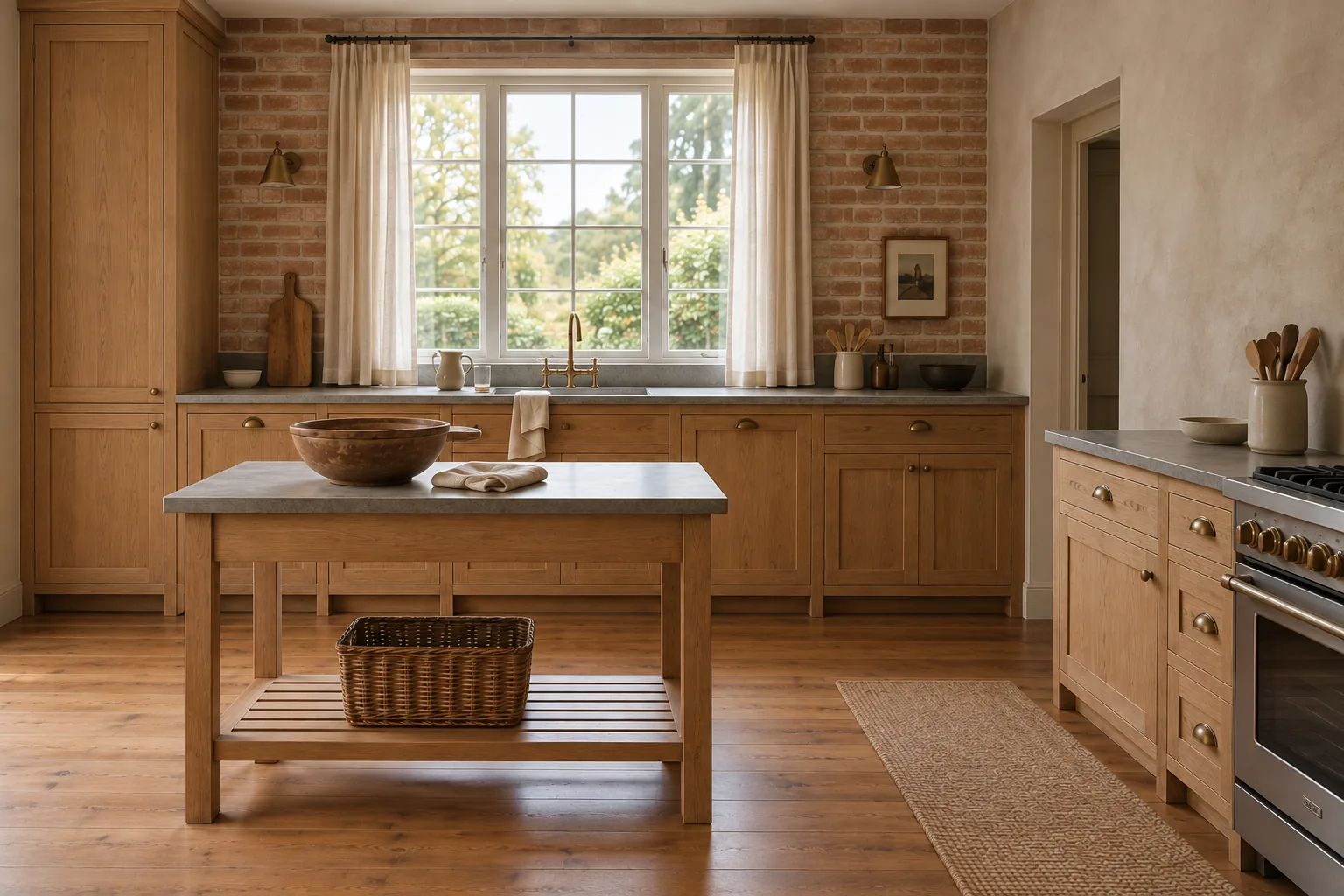
A room can be convincing from the doorway.
The floor has the grain of oak.
The counter carries the pale movement of stone.
The chair has the deep brown surface of leather.
A woven texture softens the window.
Everything belongs together.
Then you enter.
Your hand closes around the stair rail.
You cross the floor in socks.
You set a glass on the table.
A cabinet closes.
Suddenly the room is giving you information the photograph could not.
The floor is colder than expected.
The grain beneath your hand is perfectly smooth because the grain exists only in the image.
The counter answers the glass with a different sound.
Nothing has necessarily become unattractive.
But the experience has changed.
We do not live in photographs.
How appearance became enough
Modern manufacturing has become extraordinarily good at separating the look of a material from the material itself.
Oak can be printed onto vinyl.
Marble veining can be reproduced across porcelain.
Polymers can resemble leather, wicker, stone or woven fibre closely enough that the distinction may barely register from across a room.
There are excellent reasons for this.
Imitations can be less expensive, more consistent, easier to install, simpler to maintain and better suited to water, heavy traffic or other demanding conditions.
These are genuine achievements.
But the success of imitation created an interesting habit.
We became increasingly comfortable judging materials by how convincingly they reproduce an appearance.
The floor looks like oak.
The counter looks like stone.
The chair looks like leather.
And often that is where the comparison ends.
There is something peculiar about this because many of the materials now sold as upgrades were once simply ordinary materials.
Timber.
Wool.
Linen.
Clay.
Stone.
Brass.
A pine table did not begin as a luxury proposition.
It was a table made from pine.
A wool blanket was not expensive because it possessed the prestige of authenticity.
Wool was simply the material doing the work.
Modern substitutes solved real problems, and many deserve their place.
But somewhere along the way, the image often became standard and the material itself became premium.
That reversal is worth noticing.
When the image and the thing agree
Material is more than appearance.
It has temperature.
Weight.
Texture.
Density.
Resistance.
Sound.
Sometimes scent.
And because a home is experienced at close range, we encounter those properties constantly.
Research into indoor materials increasingly treats material experience as multisensory rather than merely visual. Studies involving wood, for example, have examined touch, thermal sensation, sound, smell, mood and physiological response. 1
Material cannot be reduced to colour and pattern.
Experiments comparing real wood with imitations have found that both sight and touch influence whether people perceive a surface as natural. 2
That makes intuitive sense.
The grain visible on a timber handrail is the grain beneath the fingers.
The coolness belongs to the stone you can see.
The irregularity in linen comes from the fibre itself.
Leather creases according to its own structure.
Wood moves with humidity.
Wool responds to moisture and temperature.
Copper changes at the surface.
Clay can survive centuries and break in an instant.
What the eye sees and what the material does belong to the same thing.
There is a quiet coherence in that.
A photograph of oak can reproduce the grain with astonishing precision.
It cannot reproduce everything the grain belongs to.
The warmth under the hand.
The sound underfoot.
The way an edge wears.
The way the material responds to damage.
The way time moves through it.
This does not make imitation fraudulent.
A porcelain tile is still excellent porcelain even when it resembles marble.
A synthetic floor may be precisely the right material for a wet entrance.
The question is not whether one material is morally better than another.
It is whether we understand what has changed when appearance and substance are separated.
Living with the difference
Some differences barely matter on the day something is installed.
They become clearer with time.
Real materials have their inconveniences.
Wood can mark.
Stone can stain.
Wool needs care.
Linen wrinkles.
Leather changes colour and shape.
Brass darkens.
Those characteristics are not incidental flaws attached to otherwise attractive surfaces.
They belong to the material.
And because they belong to it, they can become part of the relationship we develop with it.
You learn which table dislikes a wet glass.
How the wool coat wants to be stored.
What happens when brass is polished and what happens when it is not.
How the floor changes where people walk most often.
The material becomes intelligible.
That can make ownership richer.
Not necessarily easier.
Richer.
The object is no longer merely a colour or finish chosen from a sample.
It is a substance behaving according to its nature.
Sometimes that also creates possibilities later.
A timber floor may be sanded and refinished.
A solid wood table may be repaired.
A wool coat can be mended.
A brass fitting can be cleaned, allowed to darken, or restored according to what the owner wants from it.
Other materials are designed around a different life cycle and may perform exceptionally well until the surface or assembly reaches the end of its useful life.
Neither story is inherently shameful.
But they are not the same story.
And the difference deserves to be considered before the purchase rather than discovered years afterward.
What is the real thing worth?
Price matters.
So does maintenance.
So does suitability.
There are situations where the engineered or synthetic material is plainly the better decision.
A wet room.
A rental.
A heavily used commercial space.
A household where caring for the alternative would become an unnecessary burden.
Choosing with intent does not mean always choosing natural.
It means knowing what has been traded and deciding whether the trade is worthwhile.
This is also where judgment should remain your own.
Ask the salesperson questions. Use their knowledge. Learn what the product costs, how it performs, what it needs, and why they recommend it.
Then touch it yourself.
Look at it closely.
Trust what you notice.
The person selling the material wants to make a sale.
You are trying to make a home.
Those are not the same decision.
And when the difference in cost is manageable, it may be worth asking what the extra money actually buys.
Sometimes very little.
Sometimes branding.
Sometimes prestige we do not need.
And sometimes it buys the material itself.
Not oak-coloured flooring.
Wood.
Not merely the visual suggestion of wool.
Wool.
Not a surface designed to evoke stone.
Stone.
That may mean accepting maintenance.
Variation.
Wear.
The possibility that the thing will change rather than remain visually fixed.
Those are not automatically disadvantages.
Sometimes they are the qualities we were paying for.
There is no need to turn the decision into an ideology.
Only a more complete comparison.
Two materials can look nearly identical in the showroom and offer very different experiences over ten years.
Appearance deserves a place in the decision.
It should not get the whole vote.
What surrounds us
A home is experienced much closer than the photographs used to sell it.
Feet cross the floor.
Hands find the same rail every morning.
Arms rest against counters.
Curtains pass through fingers.
A chair becomes familiar because someone sits in it again and again.
The materials around us form the physical background of ordinary life.
That makes their substance worth thinking about.
Not because every surface must be natural.
Not because imitation is failure.
Not because expense proves taste.
Simply because substance matters as well as appearance.
Look at the surface.
Then touch it.
Listen.
Ask what it actually is.
Ask how it will behave when the room has stopped being new and become somewhere you live.
And when the real material is practical, within reach and suited to the life it will lead, perhaps it is worth the difference.
The photograph lasts a moment.
The material surrounds you for years.