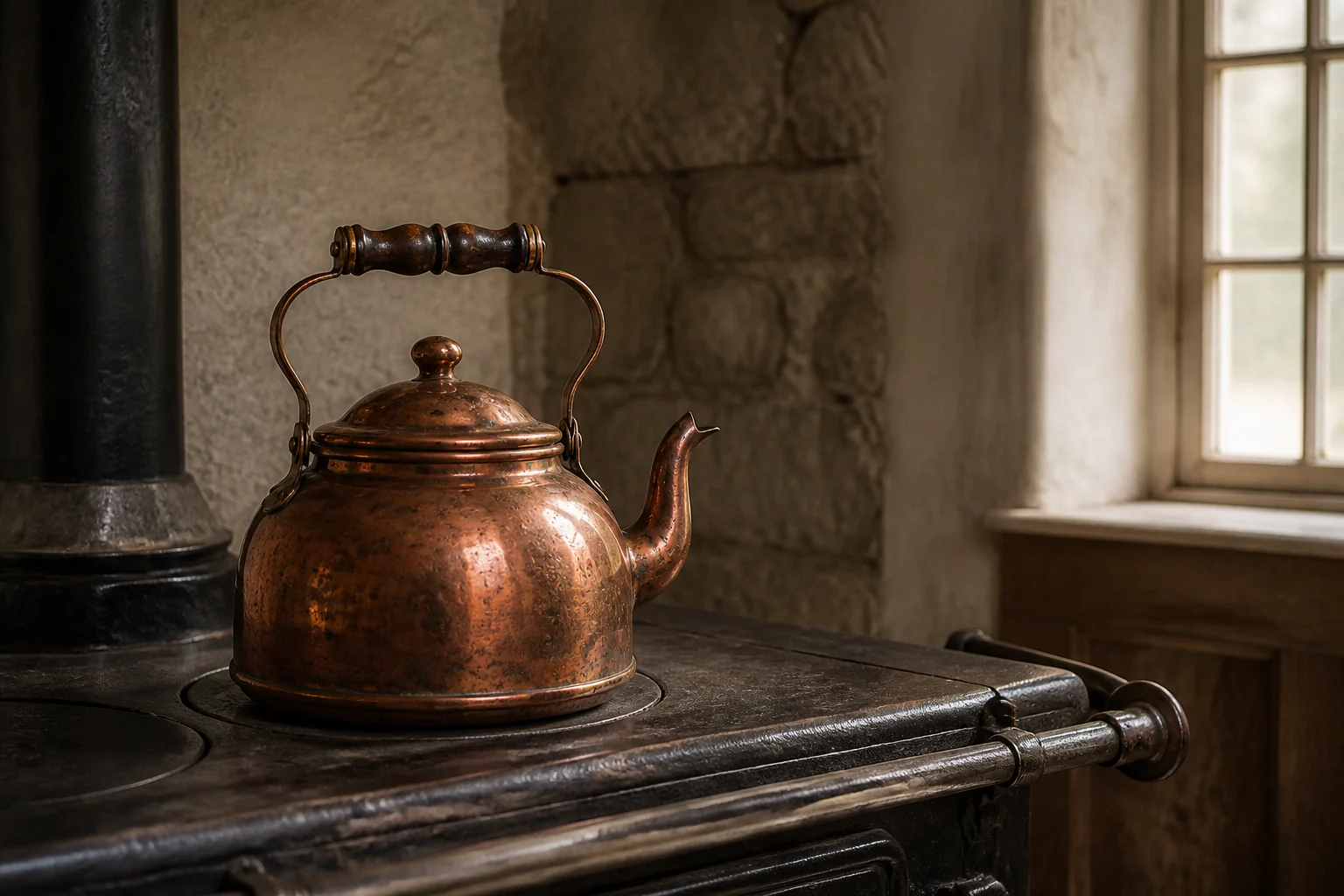
A copper kettle can become more beautiful after years of use.
Its surface darkens unevenly. The handle carries a polish where hands have held it. The base records heat. Small marks appear that no manufacturer would have designed and no new object could honestly imitate.
Then, one day, a different mark appears.
Powder gathers near a seam.
A fitting loosens.
The interior is no longer simply stained; it is deteriorating.
The kettle is still old.
But age is no longer the useful description.
The question has become whether anyone is caring for it.
Patina is not a synonym for damage
We use patina generously.
Sometimes too generously.
The word can become a flattering label applied to almost any sign that an object is no longer new: tarnish, scratches, fading, dents, grime, cracking, rust.
Conservation practice makes a more useful distinction.
On copper and copper alloys, for example, stable surface layers can form that are coherent and adherent. The Canadian Conservation Institute notes that these stable patinas may be brown, black, green, blue or other colours and can protect the underlying metal from further reaction. Active corrosion is different: powdering, flaking and rapidly developing corrosion products indicate continuing material loss.1
Both surfaces can look “old.”
Only one is stable.
That is the first lesson of patina.
Appearance is not enough.
Good wear has a pattern
The most convincing signs of age usually tell you something about use.
A stair tread wears in the centre.
Leather darkens where it is handled.
A wooden tabletop picks up fine scratches where plates have travelled.
A brass knob becomes brighter at the point of contact.
The coat cuff changes before the middle of the sleeve.
These marks have a logic.
They describe the relationship between an object and the people who used it.
That is why convincing age is difficult to manufacture.
Real wear accumulates according to behaviour.
Artificial distressing often distributes “history” as decoration.
This does not mean every mark of use is desirable.
A deep gouge can still be damage. A stain can still require treatment.
But wear earns much of its character from being specific.
It tells the truth about what happened.
Care does not mean making old things look new
There is a particular kind of maintenance that becomes destructive because it is too enthusiastic.
Metal is polished until original surface detail is lost.
Wood is aggressively stripped because a finish has darkened.
An old object is sanded smooth until the small evidence of manufacture and use disappears with the scratches.
Professional preservation standards repeatedly favour the gentlest effective treatment and repair of existing material before replacement.2 That restraint is not timidity. It recognizes that surfaces carry information.
The objective of care is not always restoration to an imagined first day.
Sometimes the better intervention is smaller.
Clean what is dirty.
Stabilize what is failing.
Repair what is broken.
Leave what is merely old.
Neglect also has a pattern
Neglect is not simply “lots of patina.”
It is care that did not happen.
Water was allowed into the same joint repeatedly.
A loose component was left to work against the material around it.
Leather dried until it became brittle.
A wool garment was stored dirty and insects found it first.
The roof leak was noticed only after the plaster fell.
A small failure became structural because no one responded while the remedy was still small.
The distinction matters because romantic language can make deterioration sound noble.
It is possible to admire the look of something while missing the fact that it is being consumed by the process creating that look.
Copper demonstrates this especially clearly. A dark, stable patina may be entirely acceptable; bright powdery corrosion can signal an active problem that needs intervention.1
The object's appearance cannot be separated from its condition.
The danger of pristine
There is another mistake on the opposite side.
If neglect romanticizes damage, obsession with newness erases age too quickly.
A table is refinished because the surface has a few honest marks.
Old hardware is replaced because its finish has mellowed.
Leather is treated until every crease is regarded as a defect.
A historic floor is removed because the boards are irregular even though they remain serviceable.
The U.S. National Park Service's preservation standards describe historic buildings as physical records of time, place and use and encourage retention of changes that have acquired significance rather than automatically returning everything to an earlier appearance.3
Our homes are not preservation projects in the same sense.
But the idea is useful.
Evidence of time is not automatically something to correct.
The mature question is not Does this look new?
It is Is this sound, useful and cared for?
Learn the material before treating the mark
Care becomes easier when it begins with identification.
What is the object made from?
What finish is on it?
Is the colour change superficial?
Is the material actually weakening?
What happens if this cleaner, oil, polish or abrasive is applied?
Many well-intentioned treatments cause their own damage. The Canadian Conservation Institute notes that inappropriate polishing compounds and residues can contribute to localized corrosion on copper alloys.4
The lesson is larger than copper.
A material should not be treated according to a generic instinct for cleanliness.
Understand what you are touching before deciding how clean it ought to look.
Sometimes the best first action is simply to stop.
A useful object should be allowed to have a life
Stewardship is not the preservation of perfection.
It is the preservation of value through use.
That means some things will change.
The chair develops a sheen at the arms.
The stone step softens at the edge.
The coat is repaired.
The kettle darkens.
If those changes are compatible with continued use, they can deepen an object's character because they belong to its history.
When the material begins to fail, stewardship asks for intervention.
That is where patina ends and neglect begins.
The exact line moves from object to object.
There is no universal colour, scratch depth or number of years that decides it.
Judgment depends on material, construction, use and consequence.
But the principle is simple enough to remember:
Time leaves marks on everything. Care determines what those marks become.