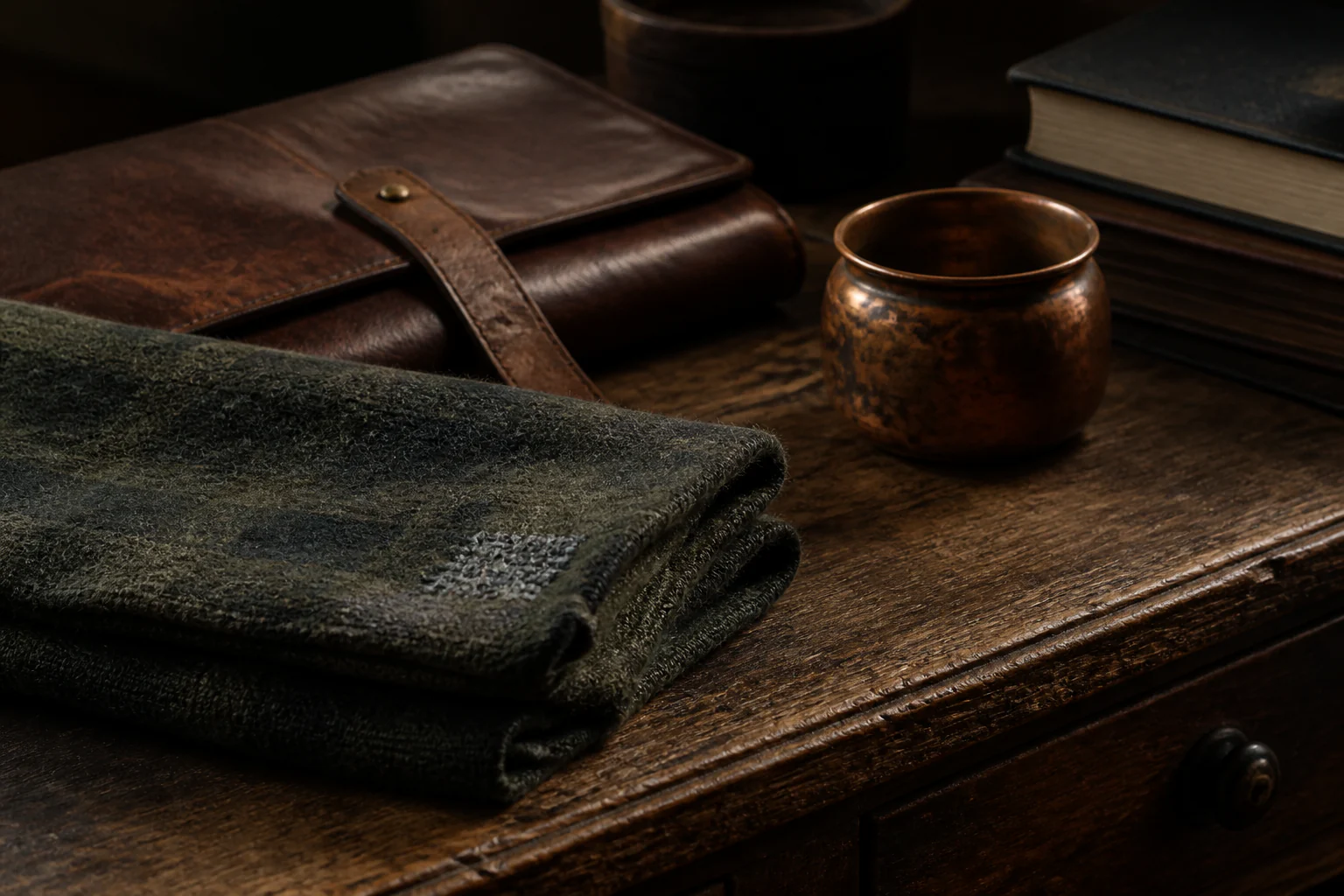
“Gets better with age” is one of those phrases that becomes less useful the more often it is repeated.
Leather gets better with age.
Wood gets better with age.
Copper gets better with age.
Linen gets better with age.
Sometimes they do.
Sometimes they dry, split, fade, corrode, weaken, warp, pill, tear or become dinner for insects.
Material quality matters.
So do construction, environment, use and care.
A material does not age beautifully because it has been placed in the category natural.
It ages according to what it is.
Wood moves
Wood never completely stops responding to its environment.
Its cellular structure interacts with moisture in the air. When humidity rises, wood can absorb moisture and swell; when conditions become drier, it releases moisture and shrinks. Repeated or extreme movement can contribute to splits, cracks and finish failure. Light can also change the colour of wood and damage finishes over time.1
Yet those same characteristics help explain why old wood can have such visual depth.
Colour changes.
Edges soften.
Surfaces acquire small compressions and scratches.
Finishes mellow.
None of that guarantees improvement.
A neglected tabletop beside a radiator can split.
A chair with a loose joint can damage itself through continued movement.
A sunlit surface can fade unevenly.
Wood's capacity to develop character is inseparable from its sensitivity.
Good ageing comes partly from allowing the material to change without allowing those changes to become failure.
Leather remembers handling
Leather is often used as the classic example of a material that develops patina.
It can darken, soften, crease and polish where it is repeatedly touched.
Those changes can be beautiful because they reveal use.
But leather is not simply improving every day it gets older.
Its collagen structure can weaken through oxidation, hydrolysis, light exposure, abrasion and environmental stress. Very dry conditions can contribute to brittleness; high humidity can encourage mould; fluctuations in humidity can produce swelling, shrinkage, distortion and splitting.2
The same leather that develops a handsome surface through careful use can become brittle through poor storage.
That is why “patina” and “condition” are different questions.
One is largely visual.
The other determines whether the material can keep doing its job.
Wool wears by fibre and by garment
Wool changes on more than one scale.
At the fibre level, its crimped structure and keratin-based internal arrangement give it elasticity and the ability to recover from bending and compression.3
At the garment level, everything becomes more complicated.
Friction can alter a surface.
Soil can become embedded.
Creases can stress fibres.
Light gradually weakens and fades textiles.
Clothes moth and carpet beetle larvae can consume wool because keratin is a food source for them.4
Construction matters too.
A strong cloth assembled poorly may fail at a seam long before the cloth itself is exhausted.
A well-constructed garment can still be ruined by bad storage.
Again, material quality does not operate alone.
A good material gives the maker and owner something worthwhile to work with.
It does not remove their responsibilities.
Metal can protect itself—or consume itself
Metals make the distinction between change and deterioration especially visible.
Many metals react with their environment and form surface layers.
On copper and copper alloys, stable patinas can become brown, black, green or blue. When coherent and adherent, those layers may slow further reaction at the surface. Active corrosion is different. Powdering, flaking or expanding corrosion products indicate continuing loss of material.5
The colour “green” does not tell you which condition you have.
That matters because visual culture often celebrates oxidized metal without asking whether the surface is stable.
Material literacy is the difference between recognizing a mature surface and admiring an object while it fails.
Textiles change even when nobody touches them
It is tempting to think wear is caused only by use.
Museums know otherwise.
Textiles can deteriorate under light, heat, humidity, pollutants and pests even while sitting perfectly still. The Canadian Conservation Institute notes that light damage is cumulative and irreversible: ultraviolet radiation can weaken fibres and visible light can fade dyes and contribute to fibre deterioration.6
This is a useful correction to the idea that careful ownership means simply “do not abuse it.”
Care often means controlling the quiet conditions around an object.
Where is it stored?
Does it stay damp?
Is it exposed to strong sun every day?
Is a wool garment clean before it is put away?
Is the heavy coat hanging from a hanger that distorts its shoulders?
Nothing dramatic has to happen for material to change.
“Natural” is not enough
Natural materials deserve much of their reputation.
They can be beautiful, repairable, tactile and capable of developing character through use.
But “natural” is not a synonym for durable.
Nor is synthetic automatically a synonym for inferior.
A badly selected natural material can fail quickly.
A well-designed synthetic material can be exactly right for a demanding application.
The more useful question is:
How does this material behave in the life we are asking it to live?
Wood moves with humidity.
Leather responds to moisture, oils, light and handling.
Wool responds to friction, pests, moisture and storage.
Metal oxidizes according to its composition and environment.
Linen softens through use but can still be weakened by light, abrasion and poor storage.
The quality of the material matters.
The intelligence of the construction matters.
The environment matters.
Care matters.
Good ageing is a relationship
There is no universal material that simply improves with time.
There are materials capable of changing well under the right conditions.
That is a more interesting idea.
Wood can become richer in colour while remaining sound.
Leather can crease and darken while staying flexible.
Wool can soften and be repaired while remaining warm.
Copper can develop a stable patina while the object continues to function.
But none of these outcomes is automatic.
Beauty in age usually depends on a three-part relationship:
material that was appropriate in the first place;
construction that respects it;
care that understands what it has become.
That is a more demanding standard than “natural.”
It is also much more useful.