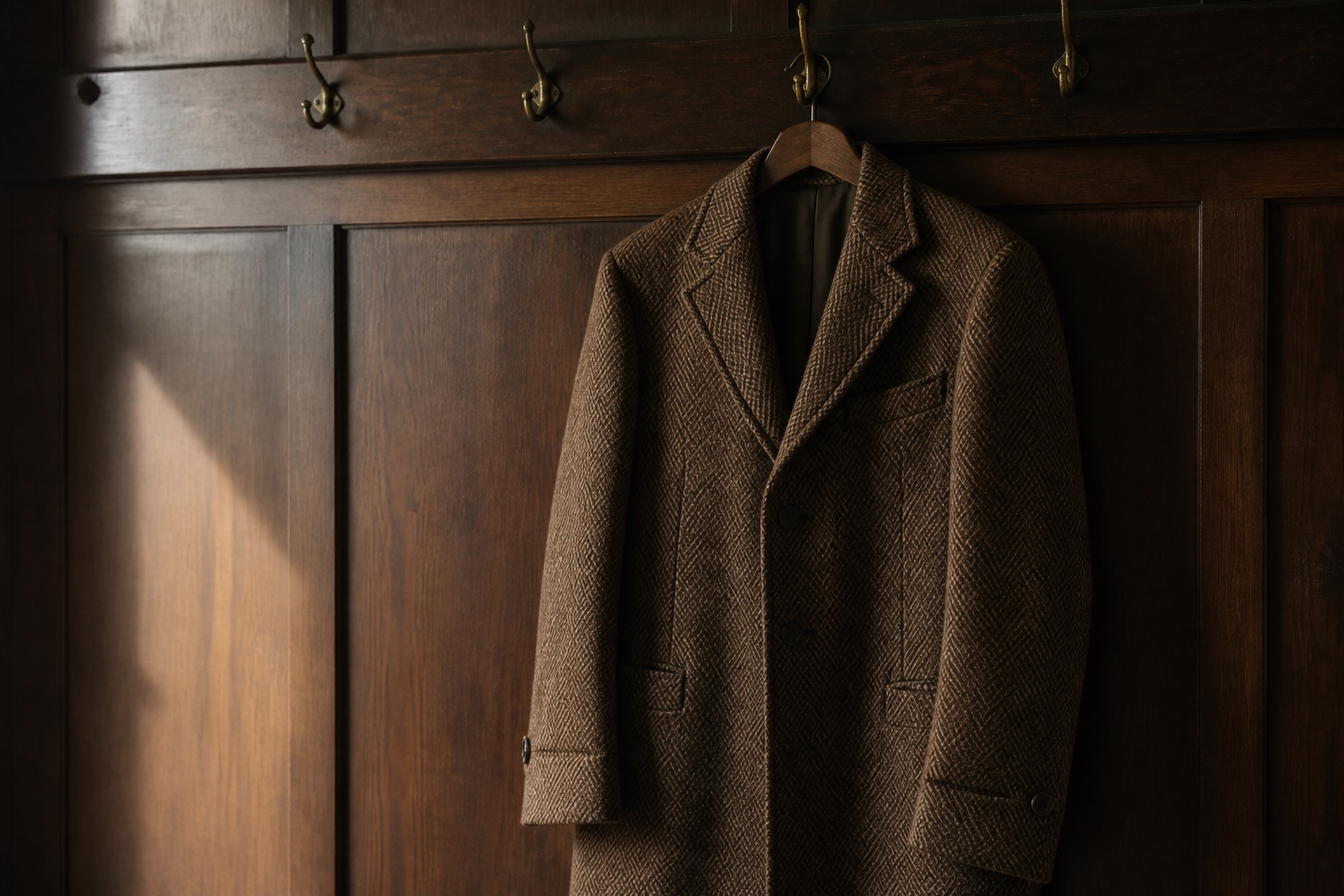
The first cold day gives a coat its annual examination.
You find it in the wardrobe, feel the familiar weight in your hands and remember, before putting it on, exactly how it will sit.
The pockets are where your hands expect them.
The collar behaves in wind.
A button may have been replaced. The lining may have been repaired at the cuff. The wool has softened slightly where a bag rubs against the shoulder.
The coat is no longer exciting because it is new.
It is better than that.
It is known.
The coat as a companion
Few garments have as much opportunity to become familiar.
A coat leaves the house with you for months at a time. It stands between clothing and weather, takes the first abrasion from trains and car doors, absorbs the indignities of restaurant coat hooks, and appears in photographs across years that otherwise have very little in common.
A good one gradually becomes less like an outfit and more like equipment for a season.
That is part of the case for owning one well.
Not because minimalism requires every person to possess exactly one coat. It does not. Climate, formality, work and personal style may make several kinds of outerwear entirely sensible.
“One good coat” is a principle.
It means allowing at least one important garment to be chosen for a long relationship rather than a short impression.
Choose the life before the coat
The easiest coat to admire is not always the easiest coat to live with.
Before fibre content, lapels or buttons, there is a more basic question:
What does this coat need to do?
A person walking through wet coastal winters needs something different from someone moving between a car and an office in dry cold.
A coat worn over tailoring needs room for tailoring.
A coat intended for daily transit may need pockets that actually hold things and cloth that tolerates friction.
The long, dramatic coat that looks magnificent standing still may become an irritation if every ordinary day requires getting in and out of a compact car.
Quality begins with suitability.
The best construction in the world cannot make the wrong object right for the life it has been asked to serve.
This is one reason thoughtful wardrobes often feel calmer than impressive ones.
The garments have jobs.
Material matters because life happens to it
Wool has remained central to cold-weather tailoring because its fibre structure gives it useful resilience, elasticity, drape and resistance to wrinkling. The International Wool Textile Organisation notes that wool fibres can bend repeatedly and recover, while Woolmark describes the fibre's crimp and internal structure as contributing to shape recovery, durability and moisture management.1 2
That does not mean every wool coat is good.
“Wool” on a label tells you the fibre family, not the quality of the finished garment.
Cloth varies.
So do weave, weight, finish, lining, interlinings, seams and the care taken during construction.
A very soft cloth can feel luxurious in a fitting room and still be poorly suited to years of abrasion. A sturdy cloth can last impressively and still be wrong if it is too heavy or rigid for the wearer.
Good material is not the material with the most romantic name.
It is material suited to the work.
Construction should make continued ownership possible
Much of a coat's construction is hidden precisely when it matters.
Seams carry strain.
Lining allows the coat to move over the clothing beneath it.
Buttons and buttonholes repeat the same small mechanical task hundreds of times.
Hems take abuse.
Pockets are pulled from the inside.
A well-made coat does not have to be indestructible.
It should be intelligible enough to maintain.
Wool garments can be patched, seams repaired, hems re-sewn and buttons replaced; Woolmark's own repair guidance treats these as ordinary interventions rather than signs that a garment has failed.3
That is an important distinction.
Repairability does not mean a coat will never wear out.
It means wear does not automatically end the relationship.
A loose button is not a reason to replace a coat.
A torn pocket bag is not a tragedy.
A damaged lining can often be replaced while the outer cloth continues to serve.
The good garment leaves room for care.
Fit becomes more important with time
A coat that is nearly right in the fitting room becomes very wrong after the hundredth wear.
The shoulders that pull slightly will continue to pull.
The sleeve that makes you wish it were another centimetre longer will continue to make the same argument.
The collar that never sits properly will not improve through familiarity.
Good fit is not about chasing one ideal silhouette.
It is about removing reasons not to reach for the garment.
Can you move?
Can you close it comfortably over what you actually wear beneath it?
Do the pockets sit where your hands naturally find them?
Does the length suit the weather and the way you travel?
Would you still choose it if nobody saw the label?
A coat becomes valuable through repeated use.
Anything that discourages repeated use deserves attention before purchase.
Care is part of the garment
One of wool's advantages is that care does not always mean washing.
Industry guidance recommends airing woven wool garments, brushing surface soil, resting garments between wears and hanging woven pieces on suitable shaped hangers.4 These are old-fashioned habits mostly because many modern wardrobes stopped expecting clothing to remain in service long enough for habits to matter.
They are also simple.
Brush dirt before it becomes embedded.
Let a damp coat dry away from direct heat.
Empty heavy pockets before hanging it for months.
Store clean wool with protection from clothes moths and carpet beetles.
Repair small failures before they enlarge.
None of this requires making clothing precious.
It makes clothing usable for longer.
The pleasure of recognition
There is a point at which a frequently worn garment stops asking to be evaluated.
You no longer wonder whether the coat works with you.
You know.
Its small imperfections become part of the inventory: the repaired lining, the slight shine at the cuff, the button that is not quite the same as the others because the original disappeared one February.
This is not an argument for shabby clothing.
There is a difference between a garment bearing evidence of service and a garment that has simply been abandoned to wear.
Brush it.
Mend it.
Press it.
Replace what needs replacing.
The aim is not to preserve the appearance of the first day forever.
It is to let the coat remain worthy of the next winter.
One good coat
The phrase is intentionally imperfect.
Some people need a raincoat, a winter overcoat and a casual jacket.
Some climates make a heavy wool coat almost absurd.
Some lives demand technical outerwear.
The point is not arithmetic.
The point is depth of ownership.
Choose at least some clothing slowly enough that it has a chance to become familiar.
Choose material for the life it will lead.
Notice construction before branding.
Fit the body you actually have and the clothes you actually wear.
Then care for the garment as though continued usefulness were part of the purchase.
Because it is.
A good coat does not remain good by magic.
It becomes your coat because winter after winter, both the garment and the person wearing it keep showing up.