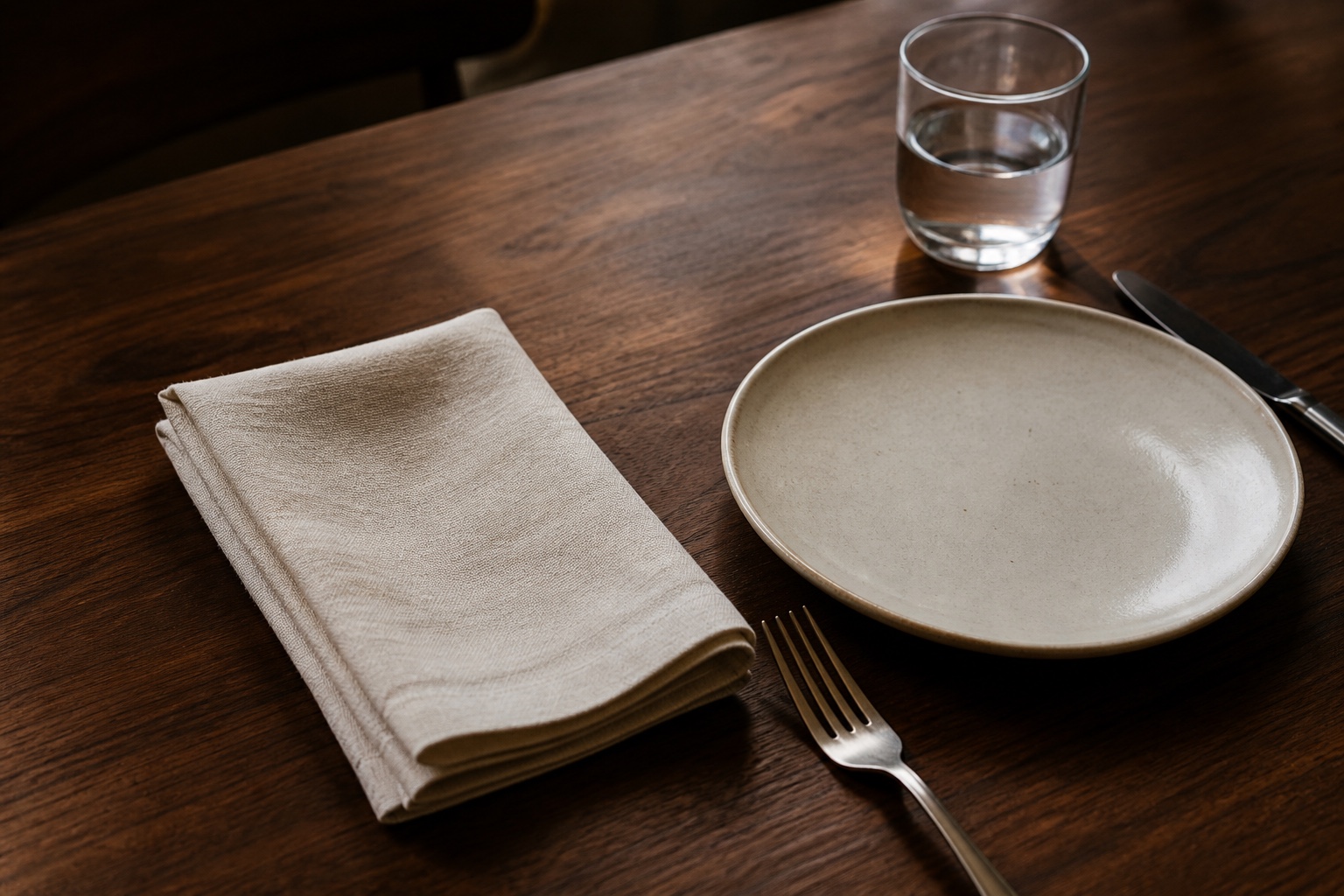
A beautifully set table can make a napkin look like architecture.
Folded into a standing fan.
Threaded through a ring.
Knotted.
Pleated.
Placed beneath a menu card with a sprig of something fragrant tucked into it.
There is nothing wrong with beauty at the table.
But the napkin has survived for a simpler reason.
It is useful.
Put it to work
Modern Emily Post guidance is refreshingly direct: when you sit down, put the napkin in your lap and use it throughout the meal. It is there to deal with small messes and keep the diner presentable while eating with other people.1
That practical purpose gets lost when the napkin is treated as an ornament that must somehow remain immaculate until dessert.
A napkin is supposed to be used.
Blot the mouth before drinking when needed.
Deal discreetly with a small spill.
Keep hands and appearance tidy.
When leaving the table, current Emily Post guidance recommends placing it loosely to the left of the setting rather than putting a soiled napkin on the plate or chair.2
None of this is complicated enough to deserve anxiety.
The object is there to make dining easier.
Even old rules could be practical
Historical etiquette was not always as rigid as its reputation.
Emily Post's 1922 discussion of formal dinners becomes almost comic when she describes the difficulty of keeping a napkin, gloves and fan balanced on a satin-covered lap. The formal rule and the physical reality collide, and practicality wins.3
By 1955, her advice had become simpler still: the important thing was that the napkin stayed on the lap.4
That is a useful reminder.
Etiquette at its best is not an elaborate system for giving diners something to get wrong.
It is a collection of habits that reduce awkwardness for everyone at the table.
The napkin protects clothing.
It helps keep the glass clean when you drink.
It deals with the ordinary physical reality that eating is not a perfectly tidy activity.
Its form serves conduct.
The table is shared space
Table manners can seem strangely personal.
What difference does it make to anyone else where a napkin sits?
The answer is the same as with most useful manners: small habits keep shared experiences from becoming unnecessarily unpleasant.
The napkin in the lap keeps the used cloth away from common surfaces.
Using it discreetly keeps the visible mechanics of eating from dominating the meal.
Placing it loosely beside the setting when finished communicates that the meal is over without leaving a crumpled cloth in the plate.
No single action is morally important.
Together, they support ease.
That is what good table manners are usually doing beneath the choreography.
They make it easier for several people to eat, talk and remain comfortable in close proximity.
Form earns its place
A linen napkin can still be beautiful.
The cloth may complement the table.
Its weight may feel pleasant in the hand.
A monogram can carry family history.
A simple fold can make a place setting feel finished before anyone sits down.
Form is not the enemy of function.
The mistake is forgetting which one gives the other its reason to exist.
The napkin is not decoration.
It is an object designed to participate in the meal.
That makes it an unusually complete little expression of Manner and Form.
The material object shapes behaviour.
The behaviour gives the object meaning.
And when dinner begins, the beautiful thing on the table should end up exactly where it belongs:
in use.