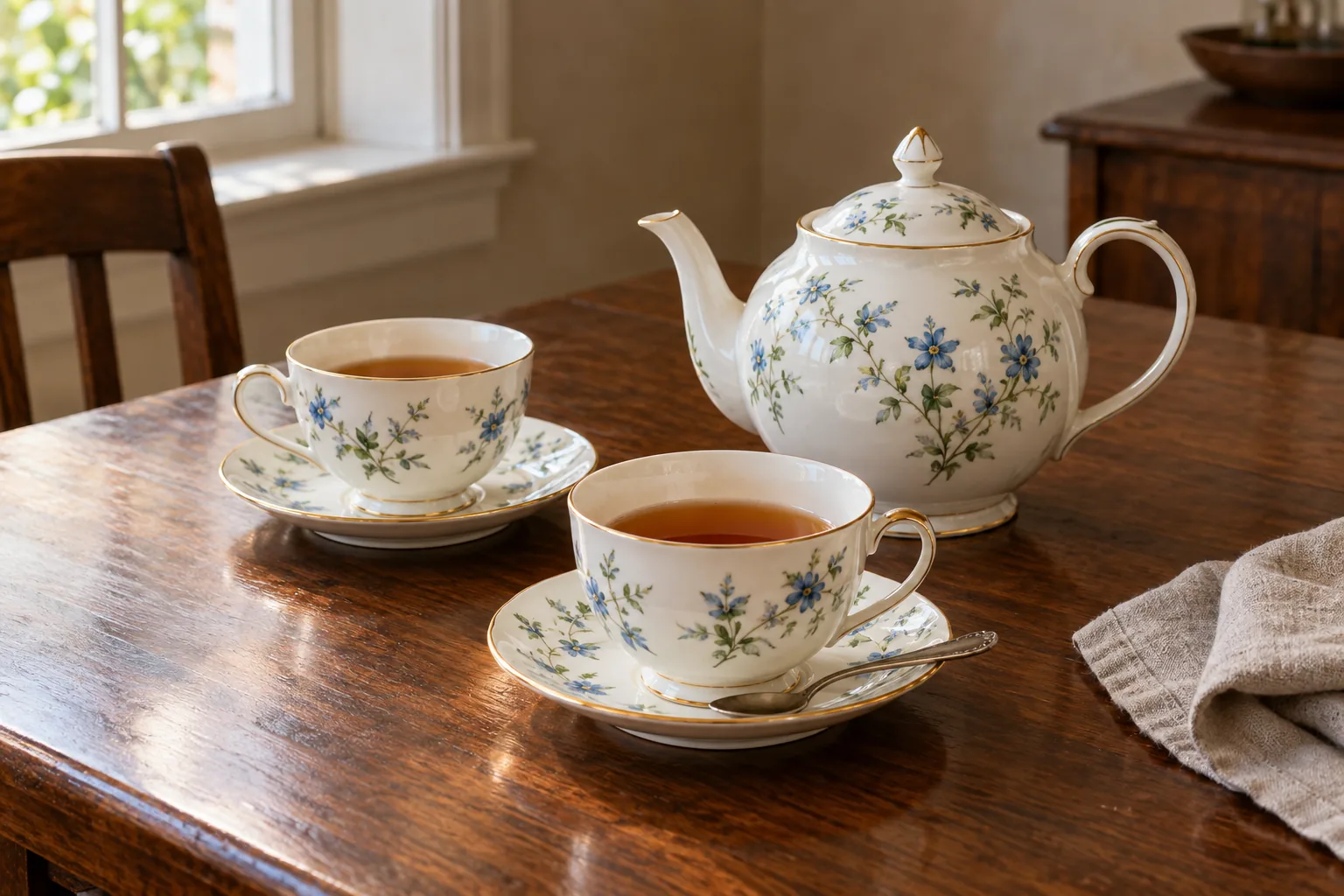
There is a cupboard in many homes where useful things go to become precious.
The good glasses.
The china inherited from someone who used it more often than we do.
A linen tablecloth still folded along the same creases.
Perhaps a serving dish nobody quite trusts themselves to carry across the kitchen.
They are not neglected.
Quite the opposite.
They are protected because they matter.
So another dinner passes without them.
Christmas seems too crowded. A birthday feels too casual. The guests have young children. Someone might chip something.
There will be a better occasion.
Eventually, an object bought or inherited for use can spend years waiting for a life important enough to deserve it.
That is a peculiar fate for a good thing.
A life begins in use
Objects are more than their materials.
A table is timber, joinery and finish. But after enough years it also contains birthdays, arguments, homework, late dinners and cups of tea left beside someone who needed company.
A coat is cloth, lining and buttons until winters begin accumulating inside it.
A serving dish can be porcelain and glaze, but if it belonged to your grandmother, placing it on the table may bring something of her with it.
No anniversary in her honour is required.
Put potatoes in it on Sunday.
For an hour, the object does what inherited things can sometimes do better than photographs: it allows someone absent to participate quietly in ordinary life.
That is how an object gathers a second kind of value.
Not the value it had when it was made.
The value that comes from belonging somewhere.
Someone remembers where it came from.
Someone remembers who always used it.
Eventually someone may remember you using it too.
A life locked away may be preserved.
But it is not being lived.
Waiting can make waiting harder
There is an interesting tendency in the way we treat things we have decided to save.
Researchers Jacqueline Rifkin and Jonah Berger found that when people avoid using an ordinary possession because they are saving it for a special occasion, the act of saving can make the object feel more special. Once that happens, fewer occasions seem worthy of it, so use is postponed again. They call this a specialness spiral. 1
Anyone with a bottle kept for “someday” already understands the mechanism.
At first, Tuesday is not special enough.
Then dinner with friends somehow seems too ordinary.
Christmas already has another bottle attached to it.
A year passes, and opening this one without a sufficiently important reason begins to feel almost disrespectful.
Nothing about the bottle changed.
Our relationship with it did.
We can value something so highly that we slowly make it unusable.
The occasion may come afterward
Part of the problem is imagining that meaningful occasions always announce themselves beforehand.
Some do.
Weddings.
Anniversaries.
Christmas dinner.
A milestone birthday.
But much of life becomes important only in retrospect.
A friend stays for dinner because neither of you is ready to end the conversation.
Family comes by on a Sunday when nothing in particular is being celebrated.
Four people sit outside because the evening is unexpectedly warm.
Someone opens the bottle.
Someone brings out the good dish.
Only afterward does the evening acquire weight.
This is what saving everything for a special occasion gets slightly wrong.
Sometimes the occasion deserves the object.
Sometimes the object helps create the occasion.
The good tablecloth changes an ordinary table.
The glasses you usually protect make a simple drink feel intentional.
Your grandmother’s dish turns dinner into a small act of remembrance without anyone needing to declare it one.
Good things can give ordinary life a little more gravity.
That is one reason to have them.
The cost of use
Of course, the fear behind all this is not imaginary.
Things break.
Shoes scuff.
Linen stains.
Wood acquires rings.
A coat catches on something sharp.
The first mark can feel particularly painful because it ends the brief period when perfect preservation was still possible.
But a useful thing cannot fulfil its purpose without encountering use.
The answer is not indifference.
It is care.
Use the object appropriately.
Know what it can tolerate.
Clean it properly.
Repair it when necessary.
Store it well.
The point of stewardship is not to prevent a worthwhile thing from having a life.
It is to help that life continue.
The first scratch on a table may bother you.
Years later, some of those marks will simply belong to the table you know.
Leather softens around its owner.
Linen relaxes.
Silver acquires the fine evidence of being handled.
Not every mark is beautiful, and neglect should never be confused with character.
But neither should evidence of life be treated as failure.
When preservation is the purpose
There are, of course, things whose value now depends on being protected.
A fragile letter in a grandparent’s handwriting.
A textile too delicate for ordinary use.
An object whose historical or emotional importance greatly exceeds whatever practical work it once performed.
Such things can reasonably become archives.
Their continued existence is part of what we are preserving.
But most household objects were not made for that life.
The cup wants tea.
The coat wants weather.
The dining room wants people.
A chair wants someone to sit down.
There is something backwards about arranging a life in which hypothetical future occasions always receive our best things while the people actually living with us are given the ordinary version.
Guests can certainly be honoured with what is finest.
So can Tuesday.
Use the good things
Perhaps the hardest step is the first one.
Once the shoes have touched pavement, they become shoes.
Once the linen has survived dinner and a wash, the fear of that first meal is gone.
Once the bottle is open, it no longer needs to justify the years spent waiting for it.
Sometimes the next suitable occasion is enough.
Not the perfect one.
Invite people.
Set the table.
Wear the coat.
Open the bottle.
Put your grandmother’s dish out with dinner.
Then care for these things well enough that you can do it again.
The purpose is not to consume good things faster.
It is to give them the chance to acquire something storage cannot provide.
A history.
Familiarity.
Association.
The marks of having been chosen repeatedly instead of merely admired.
A worthwhile possession should not have to choose between being treasured and being used.
Very often, it becomes treasured because it was used.
Good things were not made to spend their lives waiting for us.
Neither were we.