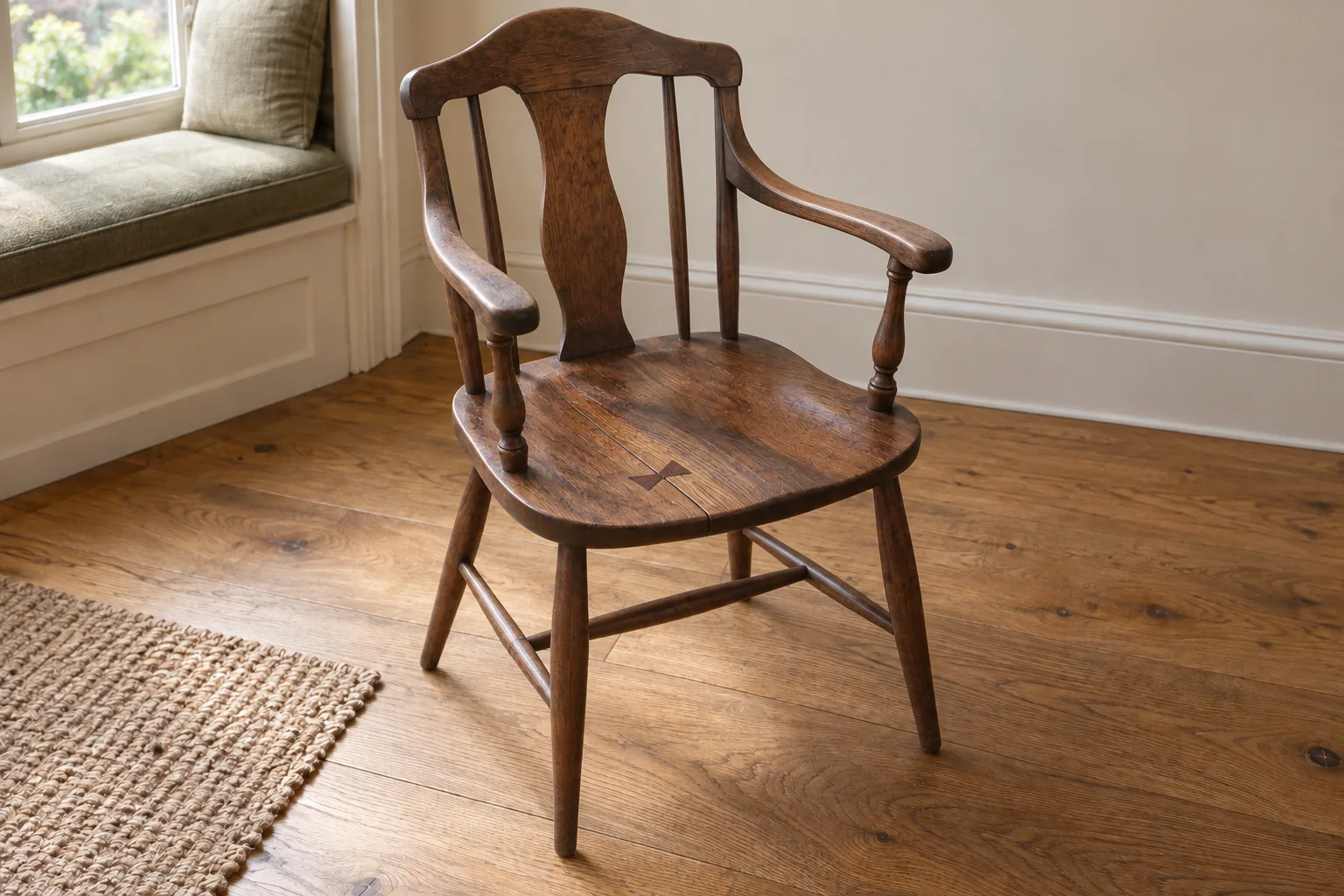
A chair breaks differently when you care about the chair.
The loose joint is still a loose joint. The repair will still cost what it costs. Another chair could probably be bought by the weekend.
And yet there you are, turning it over.
Perhaps you notice the worn underside of the seat. An old repair you had never seen before. A pencil mark left by the maker. The places where the finish has gone smooth from years of hands finding the same edge.
Suddenly the decision is not quite:
Do I need a chair?
You already know how to solve that problem.
The question is whether you want this one to continue.
That is the peculiar thing about repair.
It begins with something broken and quickly becomes a judgment about everything that remains.
What is still there?
A broken object is rarely broken everywhere.
The chair may have one failed joint while the timber around it remains sound.
A coat may need a new lining after fifteen good winters.
A lamp may require rewiring while everything you actually loved about the lamp remains unchanged.
This is part of what good construction gives us.
Not immunity from failure.
A way back from it.
Some objects are built so that wear can be answered. A component can be reached. A joint can be opened. A lining can be removed. A blade can be sharpened. A part can fail without taking the entire object with it.
Repairability exists before the repair is ever needed.
We usually discover it only afterward.
The broken chair is turned over and someone who knows what they are looking at says:
“Yes. We can fix this.”
Contained inside that answer is another one:
There is enough good chair left.
That matters.
There is little sense in preserving an object whose every failure merely exposes another. But when one damaged part sits inside something fundamentally sound, replacement can begin to feel strangely excessive.
Why discard all that remains good because one part no longer is?
The arithmetic changes
Price still matters.
It would be easy—and dishonest—to pretend otherwise.
There are repairs that cost more than replacement. Sometimes considerably more.
For an ordinary object with little distinction and no particular meaning, that may settle the question.
But money becomes less decisive when the object carries something replacement cannot reproduce.
A chair your grandfather made and a flat-packed chair from a shop may perform the same basic function.
They are not therefore interchangeable.
The same can be true of something much less grand.
The lamp that stood beside your father's chair every evening.
The watch given for a graduation.
The kitchen table that has followed a family through three houses.
The tool whose handle fits a hand partly because another hand wore it into that shape first.
Professional conservation has formal language for these things: provenance, craftsmanship, historical association, social significance. 1
At home, the language is usually simpler.
We've always had it.
Sometimes those four words change the arithmetic completely.
More than material
This is where objects become difficult to value from the outside.
To someone else, it may be an old lamp.
To you, it is the pool of light under which your father read every night.
The brass, wire and shade matter because they carry the association, but the association is not made of brass, wire and shade.
It exists somewhere between the object and the life that happened around it.
Repair can preserve that connection.
Not because the object contains the person.
It does not.
But familiar things have a remarkable ability to return us to ordinary details that memory alone does not always volunteer.
Where something stood.
How it sounded.
Who used it.
What evenings looked like when it was there.
A replacement may provide better light.
It cannot arrive already carrying that history.
That can make an economically unreasonable repair entirely reasonable.
Not every time.
But sometimes.
Love does not require immortality
The danger is obvious.
Once meaning enters the calculation, almost anything can acquire a defence.
That was your mother's bowl.
Your grandfather's chair.
The clock from the first house.
The cabinet nobody particularly likes but everyone is afraid to discard.
A family can slowly become curator of its own storage problem.
History deserves consideration.
It does not issue commands.
You are allowed to decide that an object has reached its end.
You are allowed to remember someone without retaining everything they touched.
Sometimes one object carries a person beautifully while twenty others merely occupy a basement.
Sometimes the thing has deteriorated too far.
Sometimes nobody wants to use it.
Sometimes repairing it would require replacing so much that the thing returned to you would have only a distant relationship with what you were trying to save.
Letting such an object go is not necessarily failure of stewardship.
Endings belong to stewardship too.
The important thing is that the decision was made with attention rather than indifference.
What comes after the repair?
There is one question that cuts through much of the confusion:
What happens next?
The chair comes home.
Will someone sit in it?
The coat is relined.
Will it go out into another winter?
The lamp is rewired.
Will its light return to the room?
A repair should lead somewhere.
Otherwise we may simply be preserving the idea of an object instead of its life.
This is what distinguishes repair from sentimentality at its best.
Repair points forward.
It says the past matters enough to deserve a future.
That future does not need to be another hundred years.
It only needs to be real.
A repair that gives a well-loved chair another decade of dinners can make sense.
One that temporarily holds together an object nobody trusts, wants or uses may simply postpone the same decision.
The question was never whether a sufficiently determined person could fix it.
Given enough money, skill and ingenuity, extraordinary things are possible.
The better question is whether fixing it restores something worth continuing.
The mark of having been kept
A repaired thing is not necessarily returned unchanged.
Perhaps that is part of its beauty.
The chair receives a new rung.
The coat acquires a different lining.
A tool gets another handle.
A patch remains visible where fabric once tore.
We sometimes speak about originality as though every replacement diminishes an object.
But an old thing that has been genuinely used is often partly a record of everything done to keep it going.
Professional preservation recognizes this too: retaining something often requires repair and, where necessary, compatible replacement of parts that cannot reasonably be saved. 2
There is no contradiction in that.
Continuity is not the same as untouchedness.
A hundred-year-old object that has never needed intervention is unusual.
A hundred-year-old object that bears evidence of careful intervention is alive because somebody kept answering its needs.
The repair becomes part of the biography.
Someone before us looked at the same chair, the same table, the same house and made essentially the same decision:
not yet.