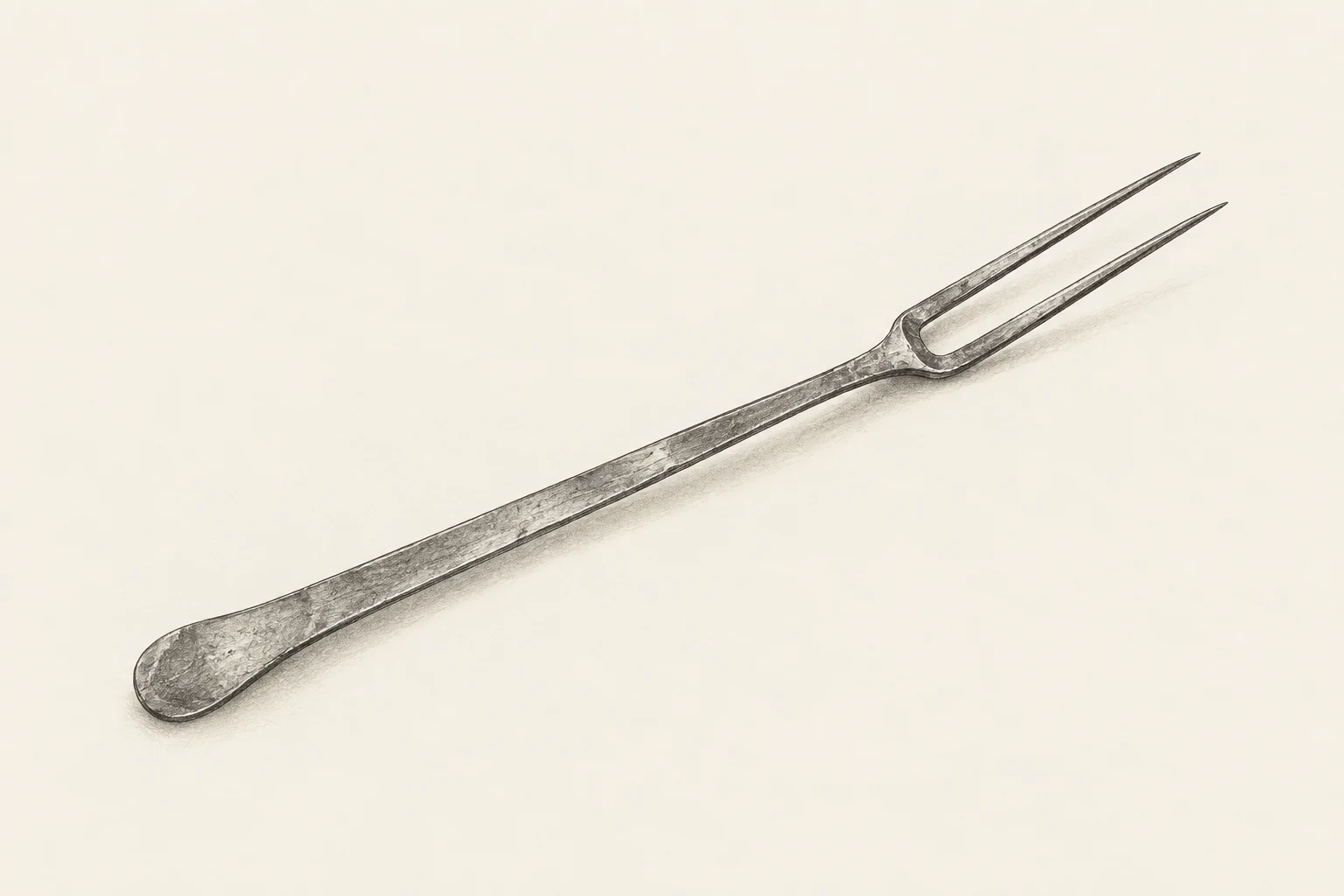
The fork is such an ordinary object that it is difficult to imagine anyone having an opinion about it. It sits beside the plate, is picked up without thought, and performs its small task so efficiently that a table without one would now seem more remarkable than a table with one. It would be easy to assume that something so useful must either have been with us for thousands of years or, once introduced, have been adopted almost immediately.
The answer is neither.
Fork-like implements are ancient, and they had been used for cooking and serving long before the individual table fork became commonplace. Small eating forks were also known in parts of medieval Europe centuries before England embraced them. In Italy, particularly, the practice had a considerably longer history. An eleventh-century account describes the Byzantine wife of a Venetian doge insisting upon using a two-pronged fork rather than eating with her fingers, and surviving Italian forks from the later Middle Ages show that the utensil was no novelty there by the time England began taking much interest in it.
This does not mean that medieval Europeans had simply failed to notice a superior tool sitting in front of them. Knives cut, spoons dealt with broths and pottages, bread could assist in handling food, and fingers were not considered an embarrassing substitute for cutlery. Specialized forks existed, including ones used for fruit, sweetmeats, carving and serving. What remained unusual was the idea that every diner ought to have one.
In 1608, the English traveller Thomas Coryate set out across continental Europe. By the time he published an account of his travels three years later, one Italian custom had impressed him enough to deserve particular attention: people ate meat with a small fork. They would hold the meat with the fork in one hand while cutting it with a knife in the other, rather than steadying or taking it with their fingers. Coryate also noticed the social reasoning behind the practice. At a shared dish, touching the food with one's fingers could give offence, since, as he observed of the Italian attitude, not every person's hands were equally clean.
Coryate found the practice sensible enough to adopt himself. He used a fork while travelling and continued to use one when he returned home.
England was not immediately impressed.
At dinner, Coryate's friend Laurence Whitaker found his new habit funny enough to mock him for it, calling him Furcifer (a Latin insult meaning roughly “rascal” or “gallows rogue,” with a convenient fork-bearing pun). The important part is that a perfectly functional eating implement could still make its user conspicuous. Coryate had encountered a practice abroad, understood the reason for it, and brought it home only to discover that what looked sensible in Italy could look affected in England.
He was not alone in attracting ridicule. Early-seventeenth-century English literature could treat fork use as one of those continental habits acquired by the excessively travelled Englishman. Beaumont and Fletcher mocked the figure of the “fork-carving traveller.” Ben Jonson was more explicit. In The Devil Is an Ass, a schemer proposes bringing the Italian use of forks into English custom, only to be met with the question: “Forks? What be they?” He proceeds to recommend them, among other virtues, for the “sparing o' napkins.” The joke worked because the audience recognized the fork as something foreign and fashionable enough to make a plausible target.
From our side of history, the resistance can seem ridiculous. The fork works. Surely that should have settled the matter.
But the English diner already possessed a workable system of knives, spoons and fingers. Adding another personal implement did not merely offer a technical improvement. For a time, it also meant adopting a manner associated with Italy, travel, novelty and refinement. The first person in a room to adopt a new convention must perform it while everyone else can still see that it is a convention.
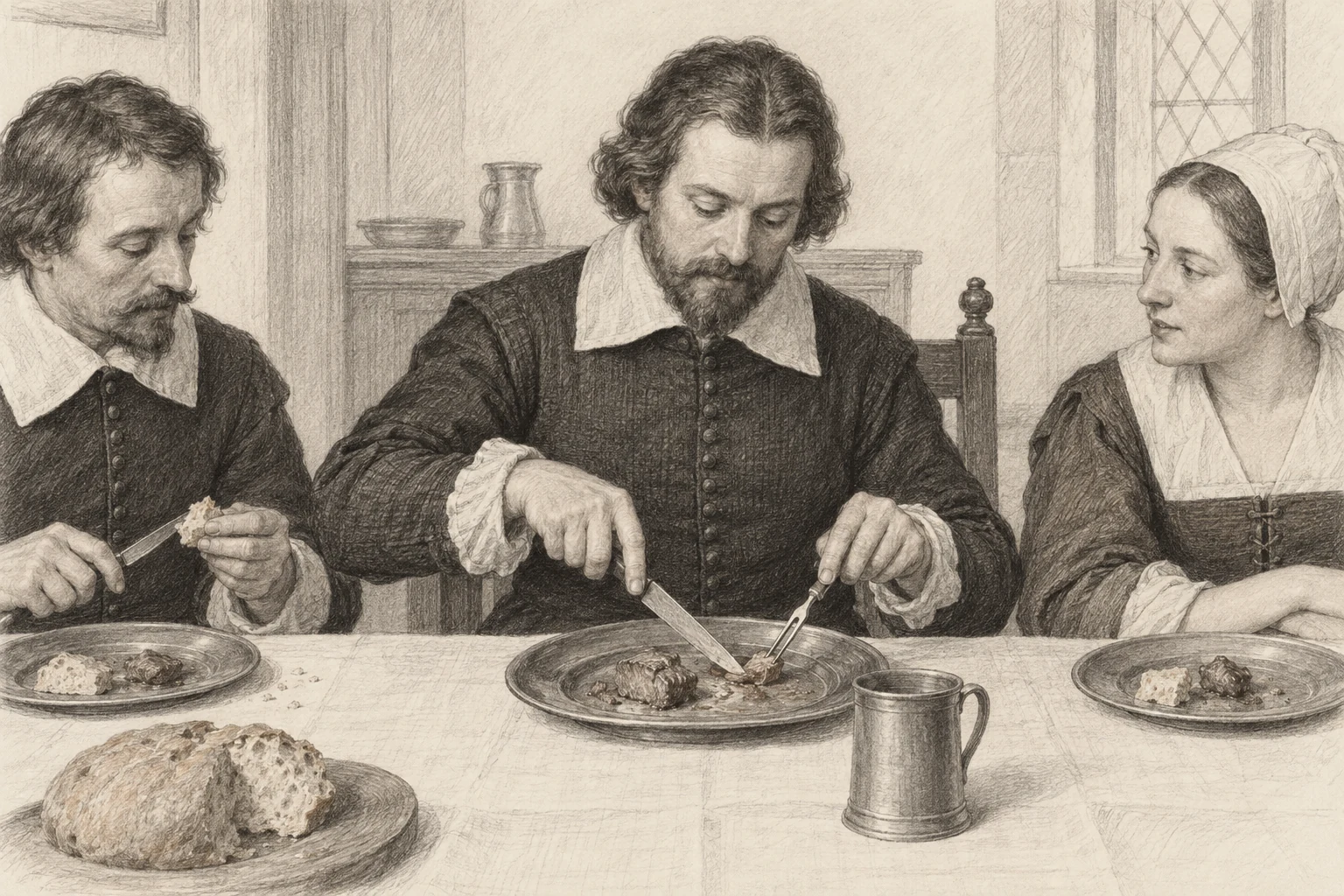
The change nevertheless continued. An English silver fork made by Richard Crosse in 1632 or 1633 survives in the Victoria and Albert Museum. It has only two tines and bears the crests of the Earl of Rutland. Its aristocratic ownership does not suggest that ordinary English households had suddenly filled their drawers with forks, but it does show how quickly the object was moving from foreign curiosity toward English possession. Only about twenty years after Coryate described being laughed at for using one, an English silversmith was making one for an English owner.
Adoption remained gradual. Individual table forks were not generally used in England until the second half of the seventeenth century, and sets became common later, particularly into the eighteenth. What now seems like an obvious improvement spent generations moving from rarity to fashion, from fashion to convention, and finally from convention to expectation.
The fork itself changed along the way. Early personal forks frequently had two long tines, closer in appearance to small carving implements than to the broad four-tined utensil now beside an ordinary dinner plate. As the fork became more firmly established at the table, its form adapted to the work people expected it to do. Habit and object changed together.
Eventually, England forgot to laugh at the fork.
Nobody now takes a seat at an English table, sees one beside the plate, and thinks of Italy. Nobody worries that using it will make them look excessively travelled or affected. The argument that once surrounded the object disappeared so completely that the object itself came to look inevitable.
It never was.
Travellers imitated what they saw elsewhere. Silversmiths made new objects for people willing to use them. Fashion weakened unfamiliarity. Manners changed. One generation's affectation became another generation's ordinary equipment.
That is one of the quiet tricks of inheritance. By the time a custom reaches us, the argument that produced it is often over.
What remains is the fork.